


BIOCONSULTING and Engineering Service, S.L. (BIOCONS)
- Home
- Companies
- BIOCONSULTING and Engineering Service, ...
- Products
- Biological Waste-Gas Treatment
Biological Waste-Gas Treatment
Polluted and odorous waste and exhaust gases can be removed most cost-effectively through biological treatment.
Most popular related searches
waste gas treatment
gas treatment
biological waste treatment
biological treatment
gas treatment plant
biological waste treatment plant
waste treatment
filter bed
gaseous pollutant
biotrickling
High-performance biological waste-gas treatment plants are required to fulfil several tasks:
- Rapid adaptation of the microorganisms to the hazardous organic compounds (chlorinated hydrocarbons, amines, mercaptane, etc.),
- Neutralisation of the biologically formed acids HCl, HNO3 or H2SO4,
- Good supply of the biomass with nutrients,
- At low energy consumption.
These requirements can be readily met with the support of moder
- TRICKLE-BED REACTORS, through
- ADAPTED, SPECIAL BIOMASS,
- IMMOBILISED with adsorbing, porous LEVAPOR carriers
Adsorbing, porous LEVAPOR-carriers measuring 25 x 25 x2 5 mm
- Weigh dry only approx. 30 bis 40 kg/m³,
- Absorb over 250 wt.% water (very important for bioactivity!),
- Suffer no loss of pressure,
- Rapidly bind special organisms and the substances to be degraded,
- Rapidly achieve maximum performance very quickly,
- Last for over 10 years.
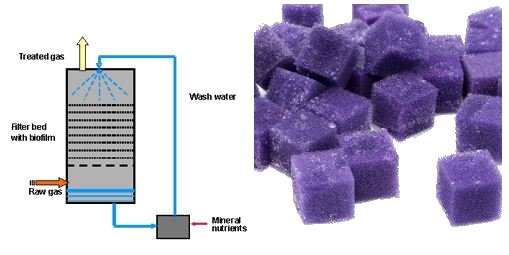
In a trickle-bed reactor equipped with the LEVAPOR carrier, a rapid and intensive exchange of substances takes place, in which the pH value can be slightly adjusted and the biomass can fed with nutrients.
Functioning of the Bio-Trickle-Bed Reactor
The exhaust gas is fed into the lower section of the trickle-bed reactor using a ventilator and then through the LEVAPOR filter bed which has been colonised with highly active special microorganisms. In the process, the gaseous pollutants on the surface of the carriers is adsorbed and immediately biologically mineralised (degraded) by the microorganisms.