

- Home
- Companies
- Weifang Senya Chemical CO.,LTD
- Products
- Bipolar Membrane Electrodialyzer BPED
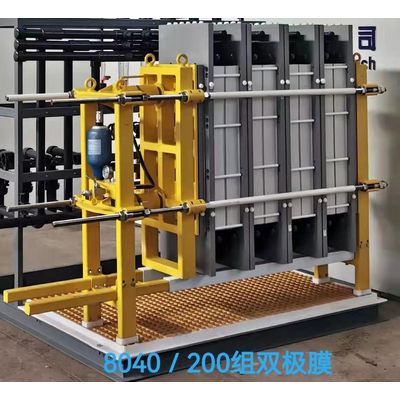
Bipolar Membrane Electrodialyzer BPED
The bipolar ion exchange membrane electrodialysis is an electrodialysis formed by combining bipolar membranes and unipolar membranes in different ways. Bipolar membrane electrodialysis combines the dissociation of salts of ordinary electrodialysis with the dissociation of H2O molecules in bipolar membranes. In this way, the corresponding salt ions in the solution combine with the hydrogen ions and hydroxide ions generated by the hydrolysis of the bipolar membrane to convert into corresponding acids and bases. Bipolar membrane dissociation water has no gas or by-products, which will reduce the voltage and maximize the use of energy. In the same bipolar membrane electrodialysis membrane stack, inorganic and organic salts can be converted into corresponding acids and alkalis. Bipolar membrane electrodialysis is mainly used for the regeneration and reuse of acid and alkali in salt preparation; clean production of organic acids and alkalis.
- Energy saving and environmental protection, a new generation of acid-base technology;
- splitting water into H+ and OH- at low voltage;
- The acid and alkali are formed from inorganic salts and organic acid salts in a single process, and the process is simple and clean;
- The concentration of acid and alkali produced is controllable and adjustable;
- no redox reaction occurs except for the electrodes at both ends, and no by-products are produced;
- Each chamber does not require electrodes, and the amount of gas generated is small. The investment cost and operating cost account for only 40 to 50% of the electrolysis method.
- Preparation of acid and bases from inorganic salts (such as sodium sulfate, sodium chloride, lithium chloride, etc.)
- Production of organic acids (such as gluconic acid, lactic acid, malic acid, succinic acid, etc.)
- Production of organic bases (such as ornithine, lysine, arginine, histidine, etc.)
- water temperature : 5-40 degrees Celsius
- oxygen consumption: < 20mg/L , It cannot contain aromatic hydrocarbons
- SS: < 1mg/L
- Fe: < 0.3mg/L
- Mn: < 0.1mg/L
- SDI: < 3
- Mg, Ca < 1mg/L
- turbidity < 1NTU
- SiO2 < 1mg/L