


- Home
- Companies
- Nexom - Axius Water
- Products
- Blue PRO - Reactive Filtration System
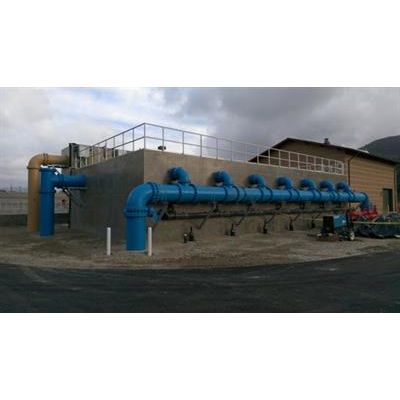
Blue PRO - Reactive Filtration System
Meet ultra-low phosphorus limits: Are you facing phosphorus or metals limits that you are unable to meet? Save money with a more efficient design: Tired of balancing dosing rates, floc quality and the excess tankage required for flocculation? There is a more efficient way.
Nexom is the exclusive source for Blue PRO® reactive filtration, the simple, powerful tool for meeting ultra-low phosphorus or metals limits. The Blue PRO uses a patented reactive filtration process within our Centra-flo® continuous-backwash media filter to achieve the industry`s lowest phosphorus or metals levels with unmatched efficiency.
Why do you need a Blue PRO® system? Blue PRO® technology installed at your plant allows you to:
-
Meet 20 µg/L (0.02 mg/L) Total Phosphorus limits
-
Meet µg/L-ng/L metals limits
-
Reduce plant chemical usage
-
Eliminate high-rate media backwashes
-
Eliminate replacement/loss of media
-
Hits industry-lowest
phosphorus levels -
Lowest capital, O&M costs
-
Continuous flow; no backwash interruptions, no changing media
-
Modular design for ease of capacity expansion
-
No change in effluent quality during backwash
-
Simple operation, lowest chemical usage ratios
-
Phosphorus removal
-
Trace metals removal
-
Municipal wastewater
-
Industrial mining
-
Water reuse (Title-22/Class 1A)
The Blue PRO filter is built on Nexom`s own Centra-flo® continuous-backwash sand filter process (pictured at right). In this process, influent is distributed across almost the entire cross-sectional area of the filter near the bottom of the sand column. Water is filtered as it flows upward, and the sand coated with hydrous ferric oxide (HFO) attracts and reacts with the phosphorus and metals. Sand is moving downward by gravity to an airlift device. While the filtered water exits near the top of the filter, the airlift transports the phosphorus- or metals-laden media up into the washbox where the discharged HFO coating and adsorbed contaminates are separated from the media. Water velocities in the washbox are carefully designed to carry away the contaminates while allowing the media to fall to the filter bed. The freshly scrubbed media from the washbox is recoated with HFO as its cycle begins again.
How the reactive filtration process actually worksThe Blue PRO reactive filtration process overcomes a critical obstacle to achieving efficient phosphorus removal in bulk aqueous solutions by providing a very large reactive surface area within the media bed, resulting in guaranteed contact of phosphorus with HFO and its high adsorptive capacity. The adsorptive surface in Blue PRO filters is a continuously regenerated HFO coating that forms on the surface of the sand media. Coagulation followed by physical separations processes (clarifiers, filters, membranes, etc.) simply cannot compare to the efficiency of adsorptive phosphorus removal.
Waste HFO, phosphorus, and solids are removed from the filter through the backwash or reject stream. Recycling this backwash upstream provides the added benefit of phosphorus pre-treatment in primary or secondary treatment systems, further guaranteeing the achievement of the discharge phosphorus target as well as lowering the overall plant chemical ratio. The phosphorus is chemically bound, exiting the site with the plant sludge. Integration of the Blue PRO technology does not require change in the plant`s sludge handling system. Blue PRO uses 30% less chemical than comparative technologies for ultra-low phosphorus, therefore producing less sludge. The waste HFO also helps with odor control and can reduce water content in biosolids.
Fits easily into existing WWTFsThe Blue PRO system is available in several models and configurations. The modular nature of the filters allows for ease of engineering system expansion. The filters are available as freestanding fiberglass or stainless steel units or can be integrated in multi-module concrete cells. Control systems and smaller filters may be mounted on skid systems for mobility or ease of commissioning.