

- Home
- Companies
- Crumpler Plastic Pipe Inc. (CPPP)
- Products
- CPP - Catch Basins, Manholes, & In-Line ...
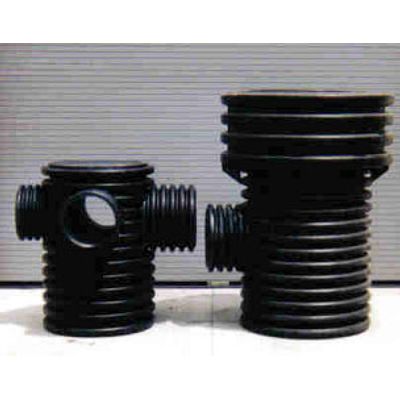
CPP - Catch Basins, Manholes, & In-Line Inlet Drains
CPP Corporation highlights the importance of proper connection points in buried pipe systems, focusing on components like catch basins, manholes, drain basins, and inlet drains. Historical issues at these junctions, irrespective of materials, emphasize the necessity of precautions, especially where traffic or soil drag-down is expected, or watertight joints are required. For surface constructions, poured concrete around connection joints and fittings is recommended to ensure durability. Field-fabricated structures can utilize CPP-fabricated or machine-molded fittings, though attention must be given to the correct orientation and backfill procedures to maintain the integrity of the installation. The emphasis on precision in connection and joint handling encapsulates the core of CPP`s installation guidelines to mitigate corrosion and enhance the lifespan of drainage systems.
In-line Inlet Drain Application Notes
Installation Guidelines
As noted in the CPP manual entitled “CORROSION RESISTANT GRAVITY DRAIN PIPES and CULVERTS” (page 11), precautions should be taken at connection points as these have historically been a problem for all buried pipe systems, no matter the pipe’s raw material base. This is especially true for connections at CATCH BASINS, MANHOLES, DRAIN BASINS, INLET DRAINS and in the union joints of such catchments requiring risers . At the surface, if traffic is expected, or at great depths where soil drag-down can occur from the soil locking into riser corrugations, or where water tight joints are required, poured concrete around all of the connection joint and part of the fitting should be employed.
In constructing FIELD FABRICATED CATCH BASINS and MANHOLES, contractors can easily employ CPP fabricated or machine molded fittings. However, in these FIELD CREATED systems, fittings or the pipes used as risers, may be oriented in a manner for which the part was not originally designed or intended. While backfill around such structures are nearly the same as that for pipe, extra procedures should be considered in the following:
- Where H-20 or greater traffic is expected, at least 6″ of concrete should be used under metal grate lids, and around the lip of the plastic part holding the metal grate.
- Where grassy swales or paved swales intersect H-20 traffic bearing catch basin grates and offer a potential moisture change in compacted soils, 6″ of concrete or an expanded 95% compacted backfill zone of dimension determined by an engineer should be used.
- CPP fabricated and machined Tee’s are often used to create catch basins, and manholes. The products were originally designed to be horizontally installed in a pipeline, not installed in a vertical manner that would put unexpected stresses on the part wall. In such field-fabricated systems where traffic is expected, 6″ of concrete should be used both at the surface and around the fittings to the haunch line of the fitting.
- CPP pipes make excellent risers in dams and drop manholes. The vertical placement of corrugated pipes does invite a soil drag-down stress on the pipe as the soil interlocks into the corrugations. Surface traffic or the continuous water flow in a dam riser will produce additional downward stress on the manhole-catch basin tee joint at the bottom of such systems. To deflect this downward stress, 6″ of concrete is recommended around the inlet top, and at the bottom around the fitting to the haunches.
- CPP fittings used in water-resistant RISER PIPE applications should be completely encased with poured concrete. In these applications, the fitting acts as a concrete form for the system being constructed because their use saves more money in field fabrication labor expense than the cost of the plastic part being substituted for the concrete form.