


- Home
- Companies
- Rapp OptoElectronic
- Products
- RAPP - Model MOM - Movable Objective ...
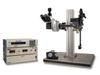
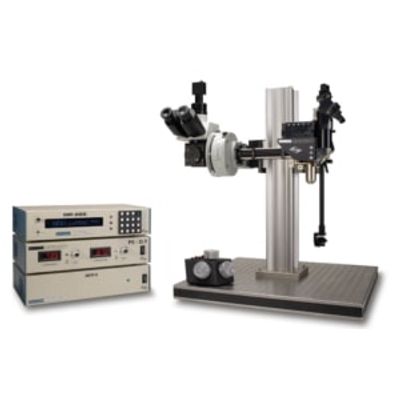
RAPP - Model MOM -Movable Objective Microscope for Two-Photon Imaging
The Movable Objective Microscope (MOM) by Sutter Instrument is a sophisticated two-photon microscope designed for advanced imaging within living specimens. This system features a unique design allowing three-dimensional movement and rotation of objectives while keeping the specimen stationary, optimizing the imaging process. The MOM integrates two independent microscopes: a wide-field section equipped with an Olympus vertical illuminator for standard epifluorescence, and a two-photon section that guides excitation laser light for deep tissue imaging. It supports precise and smooth X, Y, and Z movements with minimal drift and high reproducibility, akin to Sutter's MP-285 micromanipulator. This allows efficient Z-stack and mosaic image acquisition without moving the stage. The flexible horizontal light path facilitates conversion between upright and inverted configurations, suitable for imaging various non-horizontal surfaces. The MOM remains adaptable to evolving scanning technologies, supporting multiple scanner types, and offers customizable detector paths for optimal photon capture. Compatible with ScanImage software, it ensures seamless integration with imaging hardware.
The Movable Objective Microscope® (MOM®) is a two-photon microscope capable of imaging deep within living specimens when combined with a Ti:Sapphire Laser. The MOM design is unique in providing three-dimensional objective movement and rotation allowing the specimen to remain stationary. Many highly regarded imaging laboratories around the world use the Sutter MOM and we constantly work with our customers to adapt the design for their changing needs.
Opto-mechanical Design
The MOM consists of two independent microscopes. The wide-field half of the microscope consists of an Olympus vertical illuminator, a LED light source and camera mount to provide standard epifluorescence. The two-photon side of the microscope provides the optical pathway for guiding the excitation laser light from the table up into the scanning mirrors. From there the beam expands through the scan lens and directs into the back of the objective. Following two-photon excitation, the emitted photons are directed into the detection pathway by a dichroic mirror immediately above the objective. The main body of the microscope moves backwards on a rail system allowing easy access to the specimen prior to imaging.
The objective translates in X, Y and Z axes, it additionally rotates around the Y axis. Two moving mirrors allow the microscope to maintain efficient delivery of the excitation light to the back aperture of the objective regardless of movement or orientation. The X, Y and Z movements used are the same as controlled in Sutter’s MP-285 micromanipulator, thus movements are smooth, fine in scale, drift-free and highly reproducible. These movements allow the acquisition of Z-stacks and mosaic images of large regions of tissue without the need for a moving stage.
The horizontal light path allows for rotation of the objective away from the standard vertical position. As a result of this rotation, the MOM can easily be converted from an upright to an inverted microscope and the objective positioned from 0 to 180 degrees. This positional freedom permits the imaging of non-horizontal surfaces and volumes.