Jiangxi Aite Mass Transfer Technology Co., Ltd.

Ceramic Cascade Mini Rings for Industrial Towers

SHARE
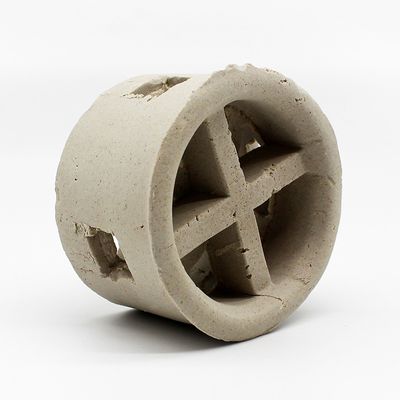
Ceramic cascade mini rings, also known as ceramic mini-rings or cascade mini-rings, are essential structured packing materials extensively utilized in various industrial applications. These rings are precisely engineered from high-quality ceramic materials such as alumina (Al2O3) or ceramic composites, chosen for their exceptional chemical resistance, thermal stability, and mechanical robustness. Ceramic cascade mini rings feature an innovative design with internal and external rims or lips, which create extensive surface areas and intricate flow paths. This design optimizes mass transfer, enhances fluid-fluid contact, and ensures an efficient separation process. The rings, typically small with diameters between 10 to 25 mm, are suitable for compact or small-scale equipment. Their practical applications include distillation columns, where they enhance the purification and separation of chemical compounds, and absorption and desorption towers for efficient gas and liquid phase transfers, such as in gas sweetening and solvent recovery processes. Additionally, they are used in packed bed reactors to support catalytic reactions and in heat exchangers for their thermal stability and resistance to fouling.
Most popular related searches
Compatibility with Process Fluids: Ensuring the ceramic material is compatible with the specific chemicals and operating conditions of the process. Pressure Drop and Capacity: Optimizing the packing design to balance the desired pressure drop and process capacity requirements. Installation and Maintenance: Ensuring proper installation and accessibility for maintenance and cleaning, if necessary.
 
Ceramic cascade mini ring lowers cylinder height and thins thickness and adds flanging on the side ends.
The flanging design increases mechanical strength of cascade mini ring. It also increase the directional possibility because it breaks the symmetry of packing structure. Besides, the contacting between random packing is transferred from line contacting to point contacting. In this way, it can increase the void between random packing particle and reduces the pressure drop. Besides, it can increase the mass transfer efficiency than ceramic pall ring
 

Application: Ceramic cascade mini ring packing is used in drying tower and absorption tower of H2SO4 production, and other chemical, coal chemical, metallurgical, environmental protection equipment, washing tower, regeneration tower, refining tower, carbon dioxide degassing tower and synthetic tower packing.

 
Features:
Because of its large specific surface area, high efficiency of mass transfer and separation, and good mechanical strength, the ceramic stepped ring solves the problems of uneven liquid distribution in the packing layer and easy to produce wall flow, bias flow and channel flow
 

Ceramic cascade mini rings, also known as ceramic mini-rings or cascade mini-rings, are a type of structured packing material used in various industrial processes, particularly in distillation, absorption, and desorption operations.

Key features and specifications of ceramic cascade mini rings:

Material Composition:
The rings are typically made from high-quality ceramic materials, such as alumina (Al2O3) or ceramic composites.
Ceramic materials are chosen for their excellent chemical resistance, thermal stability, and mechanical strength.
Ring Design:
Cascade mini rings have a unique design with a series of internal and external rims or lips.
This cascading or corrugated design creates a large surface area and complex flow paths, which are essential for efficient mass transfer and fluid-fluid contact.
The ring size is typically small, with a diameter ranging from 10 to 25 millimeters (mm), making them suitable for use in compact or small-scale equipment.
Key Features and Benefits:
High Surface Area: The cascading design and small size of the rings maximize the surface area per unit volume, enhancing mass transfer and phase contact.
Efficient Mixing and Contact: The complex flow paths created by the cascading design promote effective mixing and contact between the fluid phases, improving the separation and mass transfer efficiency.
Chemical and Thermal Resistance: Ceramic materials exhibit excellent resistance to a wide range of chemicals and high temperatures, making the rings suitable for use in harsh process conditions.
Low Pressure Drop: The structured packing design contributes to a relatively low pressure drop across the packing bed, reducing energy consumption and operating costs.
Mechanical Strength: Ceramic materials provide high mechanical strength, allowing the rings to withstand the stresses and forces encountered in industrial processes.
Applications:
Distillation Columns: Ceramic cascade mini rings are commonly used in distillation columns, where their high surface area and efficient mass transfer enhance the separation and purification of various chemical compounds.
Absorption and Desorption Processes: The rings are employed in absorption and desorption towers, facilitating the transfer of components between gas and liquid phases, such as in gas sweetening, flue gas treatment, and solvent recovery processes.
Packed Bed Reactors: Ceramic cascade mini rings can be used as packing material in packed bed reactors, where their large surface area and chemical resistance support catalytic reactions and other processes.
Heat Exchangers: The rings can be utilized in heat exchanger applications, where their thermal stability and resistance to fouling are advantageous.