


- Home
- Companies
- Latsha Technologies
- Products
- Latsha - Chlorine Absorption System
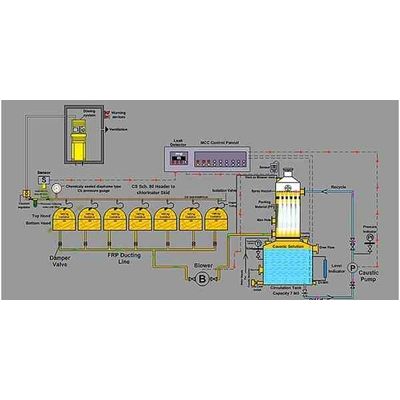
Latsha - Chlorine Absorption System
CHLORINE TONNER LEAK ABSORPTION SYSTEM ( Chlorine Scrubber) gaseous chlorine has manifold diverse uses. As its usage and handling rise, the danger associated with it also rises. As such a potential risk involves a severe emergency that may suddenly and unexpectedly occur, such eventualities should be anticipated and proper methods should be devised in advance to meet them. Nowadays the industrial safety and protection control Personnel are very serious about accident-prone poisonous gas leakage, particularly chlorine leakage.
Cl2 gas LEAKS · The most common leaks in chlorine Tonner or Cylinder are the leaks around valves and take off copper tube connectors. The other possible, severe emergency that may occur, is either due to 1. Breakdown of valves or 2. Any puncture on the wall of the Tonner. The common leaks at valves or copper tubing can be met with standard emergency kits, but the others will be grave and may suddenly and expectedly happen. It can be extensive and heavy. LATSHA TECHNOLOGIES has developed this package system to control and arrest the heavy leaks from the chlorine tonner based on the recommendations of 1. Chlorine Institute Inc., U.S.A 2. Bureau of Indian Standards 3. National Safety Council 4. Alkali manufacture’s Association of India DESCRIPTION · The package system consists of 1. FRP Gas Hood [s] 2. Chlorine gas suction blower [s] 3. Absorption tower 4. Absorption tank 5. Absorption circulation pump [s] 6. Interconnection pipes, fittings, instruments, and valves, etc., 7. Chlorine Gas Leak Detector with sensor [s] 8. Control Panel Proper care has been taken in the selection of the material of construction of equipment so that they are corrosion resistant. PROCESS · If the leak is uncontrollable, the FRP gas hood is placed over the tonner manually to cover the leaky tonner. The outlet nozzle of the hood is connected to blower suction by a flexible PVC hose and/or PVC/FRP piping. The hood prevents the leaky chlorine gas to spread into the atmosphere. Alternatively, as a precautionary method, the Hood / Hoods can always be placed over the tonner [s] which is /are in operation. The absorbent pumps and suction Blower / Fans are started [Manually or in Automatic mode]. The Blower sucks the leaked chlorine gas, directs to the absorption tower, where chlorine meets counter currently the absorbent solution. The chlorine gas is absorbed by absorbent and the air is vented at the top of the tower. As this is absorption accompanied by a chemical reaction, there will be only nil or negligible traces of chlorine in the air vent. The process of starting Absorbent Circulation Pump and Blower can be done automatically based on the signals from Chlorine Gas Leak Detector sensor[s] located close to the Tonners and in Chlorination Plant. The sufficient quantity of absorbent is continuously circulated in the tower from the absorbent tank till the tonner gets emptied. The spent absorbent, after completion of all chlorine will contain only sodium chloride, sodium hypochlorite, or sodium sulfate salts which are innocuous. This can be disposed of without any pollution problem in water treatment plant chlorinator