


- Home
- Companies
- VDH Water Technology
- Products
- CHLORINSITU - Model V - Membrane Cell ...
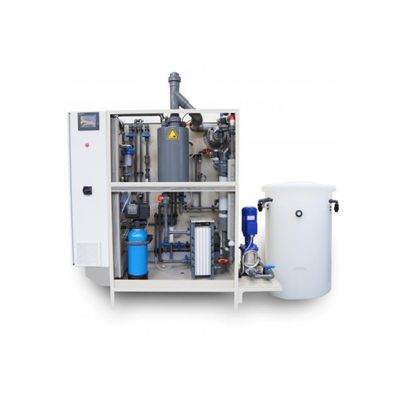
CHLORINSITU - Model V -Membrane Cell Electrolysis System
The CHLORINSITU V is a membrane cell electrolysis system in which the electrochemical reaction takes place in two electrode chambers (anode and cathode) which are separated by a cation selective membrane. The formation of active chlorine and sodium hydroxide is physically separated. In the CHLORINSITU V the freshly produced active chlorine will immediately be dosed in the water to be treated, forming in-situ hypochlorous acid. The sodium hydroxide which is being produced at the cathode side can be used for pH correction.
The CHLORINSITU V systems have to be designed for maximum chlorine demands, as peaks of capacity need to be covered by the capacity as such. The advantage of CHLORINSITU V membrane cell electrolyser systems lies in their excellent efficiency (85% yield) and no entrainment of chloride or chlorate, normally coming from the anode residue.
The electrical and chemical yield is very high. Chemical conversion is approx. 85% of brine, resulting in a low salt- and energy consumption. The hypochlorous acid concentrations in the bypass will vary from 50 – 1.000 ppm FAC.
The extremely low chloride and chlorate levels into the water to be treated are a result of the CHLORINSITU V membrane cell technology.
- Membrane cell technology
- Capacity range: 100 – 3.500 g/hour
- Production of Hypochlorous acid (HOCl) and Caustic (NaOH)
- Salt conversion: approx. 85%
- Salt consumption: 2,0 kg salt/kg FAC
- Electricity consumption: 4,3 kWh/kg FAC
- Electrical connection: 3 x 400 Vac ± 10%, N, PE, 50 Hz