

- Home
- Companies
- Contained Air Solutions (CAS)
- Products
- CAS - Model TriMAT - Class 1,2 or 3 ...
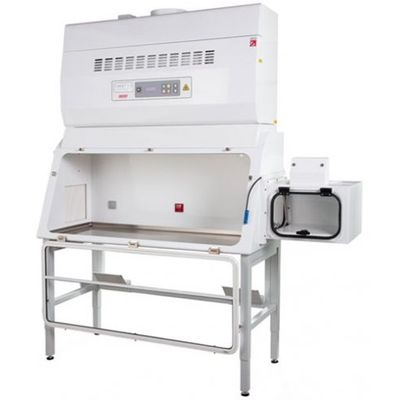
CAS - Model TriMAT -Class 1,2 or 3 Microbiological Safety Cabinet
High level of operator protection, fully compliant with EN 12469:2000.
The TriMAT system can be fitted to the full range of CAS microbiological safety cabinets and provides as standard:
- Constant exhaust volume irrespective of cabinet being ON, OFF or undergoing fumigation, which greatly assists stability of negative pressure air regimes within the containment facility
- Emergency recirculation function via a double HEPA exhaust filter in the event of remote fan failure, allowing the safe conclusion of work under containment
- The ability to handle additional room air extract volume, simplifying overall air handling design and possibly alleviating the need to install additional room exhaust facilities.
- Bypass air can be extracted via a simple grille for Containment Level 2 facilities or via a room HEPA filter for Containment Level 3 applications
The Advisory Committee on Dangerous Pathogens (ACDP) guidance on the design of containment laboratories stipulates that facilities should be maintained at a constant negative pressure (typically -30 to -50 Pa) to ensure safe containment. The use of the constant exhaust TriMAT system greatly simplifies containment laboratory air handling design by providing a fixed exhaust volume irrespective of whether the cabinet if ON, OFF, or undergoing fumigation.
Containment laboratories are normally designed to provide at least 20 air changes per hour. The TriMAT bypass module can allow significant additional room extract volume through the cabinet exhaust duct. This feature can greatly simplify overall air handling design and cost by negating the need for dedicated additional room extracts. TriMAT cabinets can also be manifolded into a central exhaust system allowing for multi-cabinet installations, further reducing design and installation complexity and cost of ownership.
Normal cabinet operations are completely unaffected by the provision of a TriMAT exhaust module on the microbiological safety cabinet. However, should the main extract fan fail during cabinet operations, the user is immediately alerted to the problem via an audible and visual alarm. The cabinet will immediately revert to recirculation operation returning exhaust air to the laboratory.
This is allowable as the TriMAT module is fitted as standard with a double H14 HEPA cabinet exhaust filter. The user can safely complete cabinet operations under full containment and then shut the cabinet down. Once the cabinet has been switched off, it cannot be restarted until the main exhaust system is healthy.
Normal cabinet operations – Cabinet ON
Lab Air
Filtered Air
Contaminated Air
- Cabinet and room exhaust is extracted through the dedicated duct
- Cabinet air is double HEPA filtered before entry to bypass module
- Room air is drawn through a non filtered grille (Containment level II), or room air is single HEPA filtered (Containment level III)
- Total volume set and maintained by upstream constant volume regulator
Normal cabinet operations – Cabinet OFF
Lab Air
Filtered Air
Contaminated Air
- Cabinet is switched off, automatically closing internal gas tight damper to isolate cabinet from room exhaust
- Total air volume now taken through bypass grille
- This arrangement allows the cabinet to be fumigated whilst maintaining negative pressure operations within the laboratory
Emergency Operation – Room Extract Fail
Lab Air
Filtered Air
Contaminated Air
- Cabinet is switched on and running normally
- Room extract failure is detected by onboard pressure sensor
- Audible and visual alarms alert the operator to room extract failure
- Cabinet maintains operation allowing user to conclude work in safety and shut down
- Exhaust air is returned to the laboratory via the double HEPA filters mounted on the cabinet
- Once cabinet is shut down it cannot restart until room exhaust system is operational