


- Home
- Companies
- Stormsaver Ltd.
- Products
- Commercial Rainwater Harvesting
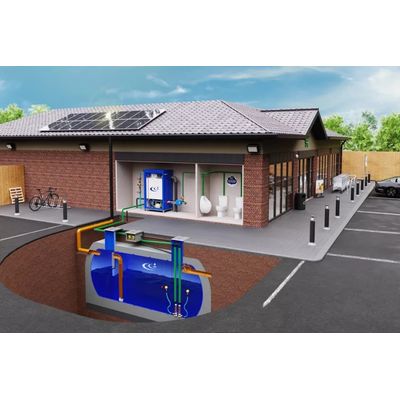
Commercial Rainwater Harvesting
Commercial Rainwater Harvesting collects and recycles rainwater from the large roof area of non-household buildings to provide a fully sustainable water supply for non-potable use. Commercial Rainwater Harvesting is a highly efficient water management method. Systems contribute towards reduced reliance on public supplies and lessened stormwater discharge rates. Stormsaver supplies fully intelligent rainwater harvesting solutions which are designed, manufactured, and tested here in the UK.
Water Availability
The UK has an estimated water deficit of 5 billion litres per day in the next 25 years, according to the UK Environment Agency. Rainwater Harvesting reduces the usage of public water supplies by meeting up to 75% of the total water demand within a building with rainwater.
Importantly, water savings are achieved without any changes to consumption habits from users.
Discharge Rates
Large buildings provide ample roof space for collecting clean rainwater, allowing this precious resource to be reused to meet the large water demands of non-household buildings. Without reusing rainwater, these large volumes would be sent straight to the over-capacity drainage network. When drainage networks become overwhelmed, untreated sewage is released into surrounding water courses.
Results
Rainwater harvesting is now commonplace in many types of buildings, including schools, hospitals, distribution centres, leisure venues, and manufacturing facilities.
Rainwater harvesting can even be combined with our on-site attenuation and greywater recycling technologies for buildings with considerably large water requirements. Live monitoring of Stormsaver’s 2,000 installations shows an average water saving of 75 percent. Discover some of our case studies here.
Rainwater Harvesting is achieved in commercial properties through a variety of methods.
Choosing the right system is crucial. Based on our maintenance expertise, the primary cause of systems failing is inadequate sizing of the internal equipment. While on paper, the system type may appear capable of delivering sufficient flow and pressure, in practice, an undersized system will struggle to meet water demands.