


- Home
- Companies
- ENMET, LLC
- Products
- ENMET - Model ProAir 2200 - Compact ...
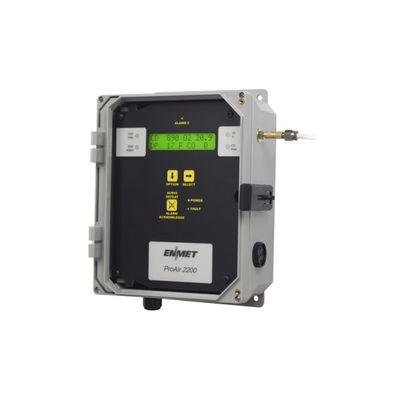
ENMET - Model ProAir 2200 -Compact Compressed Airline Monitor
ProAir 2200 is a compact, easy to install and operate compressed airline monitor that can continuously and simultaneously monitor up to four gases in real-time using internally mounted sensors. ProAir 2200 can be custom configured to monitor a variety of hazardous gases present in compressed air, including carbon monoxide, oxygen, dew point, carbon dioxide, VOCs, trace hydrocarbons and many other gases associated with OSHA monitoring requirements for Grade D breathing air.
ProAir 2200 is ENMET’s most advanced compressed airline monitor for process or breathing air requirements. It is used in a wide variety of industrial applications from aerospace to pharmaceutical and can be easily adapted to meet your specific needs for compressed airline monitoring.
- Continuous real-time gas monitoring of compressed airlines
- Can be custom configured with up to 4 sensors
- Able to withstand harsh process environments
- User programmable alarms and relays
- Meets Grade D breathing and NFPA 99 requirements
- Low flow alarm
- Field replaceable sensors
- Display: High-contrast, backlit
- Alarms: Visual: LEDs
- Audible: Piezoelectric horn, 95 dB at 2 feet
- Alarm Relays: 5 programmable gas relays plus fault. All relays are programmable latching or nonlatching, dry SPDT, 10 amps (resistive load only) at 110 VAC.
- Operating Power: 100 to 240 VAC and/or 12 VDC, 15 Watts
- Inlet Pressure: Must be regulated to 55 psi (user provided)
- Flow Rate: 1/2 liter per minute (1 SCFH)
- Enclosure: Thermoplastic box with clear, hinged front cover, designed for NEMA 12 and 4X
- Dimensions: 9.3 W x 11.9 H x 6.1 D inches (21.3 W x 30.3 H x 15.4 D cm)
- Weight: 8 lbs.
- Approvals: UL 60601-1, IEC 60601-1 & CSA 22.2, No. 601.1
- Acetone (CH3)2CO
- Acetonitrile (CH3CN)
- Acetaldehyde (CH3CHO)
- Ammonia (NH3)
- Benzene (C6H6)
- Butane (C4H10)
- 2-Butanone (MEK) (C4H80)
- Bromine (Br2)
- Carbon Dioxide (CO2)
- Chlorine (Cl2)
- Chlorine dioxide (CLO2)
- Combustible Gas
- Dew Point (DP)
- Ethanol (CH3CH2OH)
- Ethyl alcohol (C2H5OH)
- Ethylene (C2H4)
- Ethylene oxide (ETO) (C2H4O)
- Fluorine (F2)
- Gasoline
- Heptane (C7H16)
- Hexane (C6H14)
- Hydrocarbons
- Hydrogen (H2)
- Hydrogen cyanide (HCN)
- Hydrogen sulfide (H2S)
- Jet Fuel (JP8)
- Isobutane (C4H10)
- Isobutylene (C4H8)
- Isopropanol (CH3) CHOH
- Isopropyl alcohol (IPA) (C3H8O)
- Kerosene
- Methane (CH4)
- Methanol (CH3OH)
- Methyl alcohol (CH3OH)
- Methyl chloride (CH3Cl)
- Methyl ethyl ketone (MEK) (C4H8O)
- Methylene chloride (CH2Cl2)
- Natural Gas
- Nitric oxide (NO)
- Nitrogen dioxide (NO2)
- Nitrous oxide (N2O)
- Organic solvents
- Oxygen (O2)
- Pentane (C5H12)
- Propane (C3H8)
- Propylene (C3H6)
- Propylene oxide (C3H6O)
- Solvents
- Styrene (C8H8)
- Sulfur dioxide (SO2)
- oluene (C7H8)
- Trichloroethylene (C2HCl3)
- Vinyl chloride aka Chloroethene(VCM) (C2H3Cl)
- Volatile Organic Compounds (VOCs)
- Water/Dew Point
- Xylene (C8H10)