


- Home
- Companies
- Aquafix, Inc.
- Products
- Aquafix - Model Ana-Zyme D - ...
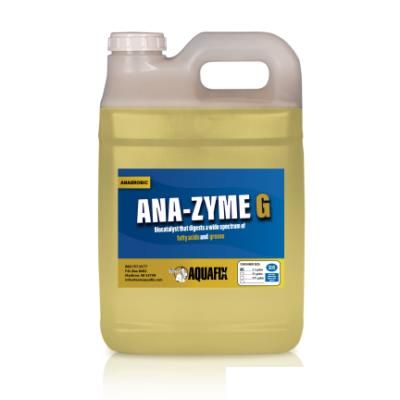
Aquafix - Model Ana-Zyme D -Concentrated Enzymes Formulated Blend
Ana-Zyme D is a blend of concentrated enzymes formulated to degrade complex and insoluble substrates found in anaerobic digestor feedstock and sludge. This biocatalyst facilitates the digestion of these materials into bioavailable nutrients helpful to the methane for ming archaea. Increasing the rate of hydrolysis will improve digestor stability and lead to better gas quality.
- Rapid Fat, Oil, and Grease Reduction: Quickly breaks down fats, oils, and grease in anaerobic digesters and lagoons.
- Prevents Grease Caps and Foaming: Helps avoid operational issues like grease caps and foaming in anaerobic digesters.
- Breaks Down a Wide Range of Fats: Effective on fatty acids like linolenic, oleic, stearic, and palmitic, as well as fish oils, triglycerides, dairy, and egg fats.
- Supports Acidogenesis Process: Promotes the production of short-chain fatty acids, essential in the acidogenesis-methanogenesis process.
Targeted Grease Degradation for Anaerobic Systems
Ana-Zyme G is a powerful enzyme-based solution for reducing fats, oils, and grease (FOG) in anaerobic digesters and lagoons. Formulated to break down triglycerides and long-chain fatty acids, it enhances acidogenesis and prevents common issues like grease caps, foaming, and system imbalance.
FOG accumulation disrupts anaerobic digestion, leading to poor gas quality and process upsets. Ana-Zyme G transforms these stubborn compounds into short-chain fatty acids essential for healthy microbial metabolism and methane production. It’s effective against a wide range of animal and plant-based fats, including fish oils, dairy waste, and egg fats.
Regular application ensures consistent digestion rates and helps protect your system from performance drops during high-grease loading. Ana-Zyme G is easy to meter in and compatible with most anaerobic treatment setups, making it a smart choice for food processors, municipal plants, and agricultural digesters.
Anaerobic Digester or Anaerobic Lagoon
- Initial Dose (Daily for 1 month) Maintenance Dose (Daily after 1 month)
- 2.5 Gal per 500,000 Gal Digester Volume .5 Gal per 100,000 Daily Inflow
Ana-Zyme G is formulated to provide immediate reduction of fat, oil, and grease in anaerobic digesters and lagoons to avoid issues with grease caps and foaming. The biocatalysts in Ana-Zyme G rapidly speed the breakdown of complex fat molecules into simple short-chain fatty acids which then break down to acetic acid, a compound used in methanogenesis.
The goal of this product is to limit volatile acid accumulation, while also increasing biogas generation, and improving volatile solids destruction.
Ana-Zyme G can degrade a range of fatty acids such as linolenic, oleic, stearic, and palmitic as well as fish oils, triglycerides, dairy, and egg fat. The production of short-chain fatty acids is very important as part of the acidogenesis–methanogenesis process.
High Levels of Grease in Anaerobic Digesters
FOG must undergo several steps to be converted into the ideal food substrate for methanogens, acetate:disintegration,hydrolysis, andβ-oxidation.
Limitations in the rates of any of these steps can lead to uneven degradation of FOG, which results in variable volatile acid loading on methanogens. Variable loading of volatile acids can easily overwhelm methanogens leading to accumulation of volatile acids, eventually resulting in a drop in digester pH. These impacts are exacerbated in systems with high FOG loading.
However, FOG can be made into an excellent food substrate for anaerobic digestion, due to their high COD content, as well as their high potential to generate large quantities of acetate or acetic acid. It just needs a little processing to get there.
Ana-Zyme G and Anaerobic Grease
Ana-Zyme G acts as a catalyst to naturally occurring bacteria to aid in the breakdown of FOG, which prevents the overloading of methanogens and frees up this new food source. Ana-Zyme G does this by targeting triglycerides and long-chain fatty acids to convert them evenly into short-chain fatty acids. This stabilization of fatty acid degradation allows methanogens to better acclimate to fatty acid loading. They are then able quickly uptake these fatty acids, reducing the chances of volatile fatty acid accumulation. In addition, Ana-Zyme G prevents the accumulation of undegraded fats in a system, which enhances volatile solids destruction, particularly in systems with limited mixing such as lagoons.
- Pair with BioGas1 to increase biogas production.