

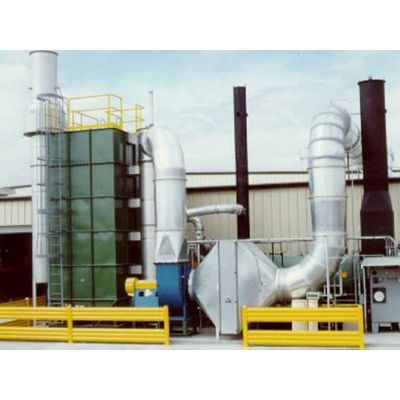
Concentrators and adsorption systems consist of vessels, or a single vessel, with multiple compartments, which house a media for adsorbing Hydrocarbons. The media can be Zeolite or Carbon. As the VOC- laden air passes through the vessel(s) in the Concentrator, the VOC’s are adsorbed by the media and clean air is released into the atmosphere. Carbon adsorbers continue adsorbing for a period of time until the media is near saturation, the VOC-laden air stream is then redirected into another vessel or set of vessels. The saturated vessel is desorbed by passing hot air through the media.
The VOCs leave the regenerating vessel with high concentrations and the regenerating system is designed so the concentration will not exceed 45% of the Lower Explosive Limits (LEL). The concentrated air stream is then directed into a small thermal oxidizer for volatile organic compound abatement and destruction. The hot exhaust is utilized to generate steam required for carbon regeneration or hot air for Zeolite regeneration. If solvent recovery is desired, the highly concentrated regenerating stream can be directed through condensers and decanters for product recovery.
Ship and Shore Environmental also provides a Rotary concentrator to concentrate low VOC concentrations in high flow rate and destroy them in a RTO, thermal or catalytic oxidizer. The concentrator adsorbs the fumes and generates a concentrated stream to be destroyed by the abatement unit. A rotary concentrator tries to concentrate VOC emissions to 10 or 15 times of the original value. Hot air for the desorbtion phase is generated in a heat exchanger installed in the exhaust stack of the abatement unit.