


- Home
- Companies
- GeSiM - Gesellschaft fur ...
- Products
- µ-Contact - Model µCP6.1 - Microcontact ...
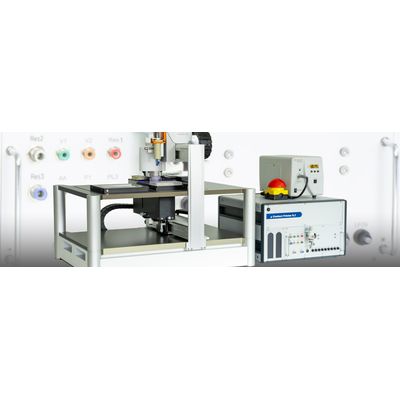
µ-Contact - Model µCP6.1 -Microcontact Printers
GeSiM microcontact printers always combine two methods on one platform: a) Microcontact printing allows surface patterning down to 100 Nanometres and b) Nano Imprint Lithography (NIL) creates tiny 3D structures in polymers. Each µCP features polymer stamps with user specific patterns. An external casting station replicates consumed stamps to keep operating costs reasonably. Click the tab Procedures for details. All GeSiM microcontact printers offer identical stamping method by pneumatic actuation and Z-movement. The compact benchtop instruments are affordable, they don’t need expensive granite beds or damping tables.
The GeSiM microcontact printers are designed to simplify prototyping of microfluidic devices and tiny 3D structures. These instruments close the gap between microfluidic research and production. They help to overcome typical design barriers:
- Photomask based lithography is expensive, each design change requires a new mask.
- Micro casting tools for mass production of disposable fluidic chips and cartridges are even more expensive.
- Biological samples quickly clog microchannels, revealing design failures and optimization needs.
GeSiM microcontact printers produce small series of tiny 3D imprints in an affordable manner. A single initial investment speeds up your R/D in the world of microtechnology.
Automatic Microcontact Printers
Our automatic platforms offer programmable sequences for liquid dispensing/spinning, built-in alignment micoscopes as well as unattended stamp picking/discarding for more complex applications.
µCP4.1
It is the most popular microcontact printer for transparent and non transparent targets (E.g. silicon wafers). It comes with alignment camera, stamp head, UV hardening and rack for up to five stamps. The max. stamp size is 20 x 20 mm. Up to five different inks/reagents can be printed by aligning all stamps to specific fiducial markers on the target.
µCP6.1
The automatic micro-contact printer has a two-level working tray which makes it perfect for UV transparent print targets. The UV source is arranged on the lower level, opposite to the print stamp on the upper level. A collimator combined with a photomask synchronizes the exposition frame perfectly to the stamp image field. This method allows multiple imprints on one target up to six inches without spacing between adjacent images (“Chessboard” style). With a patterned photo mask in the UV beam, two lithography steps at once (Photolithography and stamping) become feasible. It allows to create more complex designs in one step, e.g. tiny pillars in the center of a microfluidic channel.
µCP6.1/E
Same as before, a larger work tray adapts more targets for batch processing. All µCP6.1 instruments feature powerful but silent and precise linear motors.
Included with each instrument:
- Stamp rack for up to five individual stamps
- Alignment microscope
- UV lamp (Omnicure S1500)
- Pneumatic cartridge dispenser with heater
- Spin coater, heated substrate table
Options:
- Nanoliter pipetting unit
- Powder Pipet
Semiautomatic Microcontact Printers
Here we present solutions for low-throughput research, without the need of automatic tooling and alignment.
µCP Core
This entry-level microcontact printer offers attractive price and manages just one stamp. It fits on the stage of most popular inverse microscopes. Stamp alignment is than done by the microscope table instead of the GeSiM printer. Accessories like UV-lamp and temperature control module are available. As for the automatic printers, µCP Core uses stamps of two sizes: 20mm x 20mm and 10mm x 10mm.