


- Home
- Companies
- Careddi Technology Co. Ltd
- Products
- Continuous Devulcanization System
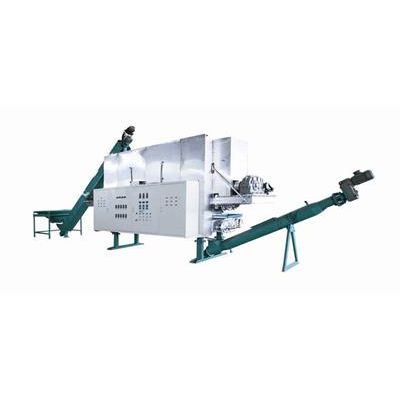
Continuous Devulcanization System
Before we describe the devulcanization process, we need to clarify Vulcanization, Vulcanization is the thermo-chemical process that incorporates sulfur and sulfur crosslinks into a mixture of rubber molecules in order to provide the elasticity and other properties that are desired in manufactured rubber products. In the process, sulfur atoms are chemically bonded to the carbon molecules of rubber molecules and serve as crosslinks (chemical bonds) between the sulfidic rubber molecules.
The vulcanization process is irreversible at standard atmospheric conditions of temperature and pressure. The vulcanization process also uses primary and secondary accelerators, typically sulfur-containing organic compounds and activators such as zinc oxide and stearic acid. Reclaiming is a procedure in which scrap tire rubber or vulcanized rubber waste is converted—using mechanical and thermal energy and chemicals—into a state in which it can be mixed, processed, and vulcanized again. The principle of the process is devulcanization. Devulcanization consists of the cleavage of intermolecular bonds of the chemical network, such as carbon-sulfur (C-S) and/or sulfur-sulfur (S-S) bonds, with further shortening of the chains also occurring . Devulcanization is the process of cleaving the mono-sulfidic, di-sulfidic, and polysulfidic crosslinks (carbon-sulfur or sulfur-sulfur bonds) of vulcanized rubber. Ideally, devulcanized rubber can be revulcanized with or without the use of other compounds, in the process of devulcanization, the structure of the vulcanized waste rubber is modified. The resulting material can be revulcanized or transformed into useful products like tires, shoes sole, conveyor belt, mat etc. Devulcanized rubber is most valuable process comparing to other tire recycling method. You know, 250 rubber trees can produce 1Ton rubber yearly. The reclaimed rubber is a great help in saving the global resources!
In the past 70 years, there are many attempts to develop the commercial devulcanization technology
worldwide. Our continuous devulcanization plasticization system is the most advanced technology in
reclaimed rubber industry.
Process Clarification:
The 9th generation electromagnetic induction heating devulcanization system, the raw material is the 30-40 mesh crumb rubber powder, by mixing the 30-40mesh rubber powder with some activator and softener, auto-feeding the rubber powder by using double screw conveyor , load the mixture powder into the reactor box, there are 7 layers double screw conveyor structure installed inside of reactor box, heating to increase the temperature inside to the range of 180-320C. Keep warm for 15-18 minutes, to let the rubber powder de-sulfured, then cool it down to get the final de-vulcanized rubber powder. It is a fully continuous system.
Comparing to the traditional de-sulfur tank system, it has following advantage
- Full automatic and continuous process with in 24 hours running.
- Easy operation, only need 1 operator per shift
- Process with no pressure, no waste emission gas, no waste water, non-pollution, safe and environmental friendly.
- Reclaimed rubber quality can be controlled stably.
- The output rubber powder can be used for making rubber products directly, no need de-watering.
- Less investment, lower energy consumption, Payback time is short within 3 month
- Mixing raw material: Mixing the 10-40 mesh crumb rubber powder together with a certain percentage of activator and softener. The normal proportion is: Rubber powder: Softener: Activator=1:8-18%:0.3-0.4%.
- De-sulfur and plasticization: Heating the mixed raw material to the temperature 180-320C degree, and keep warm for 15-18 minute, to get the de-sulfured rubber powder.
- Cooling down: Cooling the rubber powder to the temperature around 80 C degree, for packaging and application.
- Put the de-sulfured rubber powder into refinery machine for producing reclaimed rubber.