


- Home
- Companies
- Cavitation Technologies, Inc.
- Products
- CTI CaviTune - Laboratory Systems
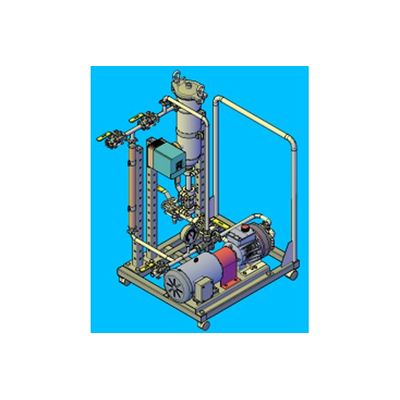
CTI CaviTune - Laboratory Systems
The laboratory stand is designed for hydrodynamic and cavitation treatment of homogeneous and heterogeneous liquids in order to intensify the processes of mass transfer, emulsification and dispersion, as well as to change the physical characteristics of the treated liquid. Hydrodynamic and cavitation treatment of the liquid is carried out in a flowing hydrodynamic cavitator, model number - LAB101. The principle of operation of the cavitator is based on the non-stationarity of the fluid flows and on the active hydrodynamic effects of the action on the treated substances. The liquid treatment in the hydrodynamic cavitator is implemented by the impulse multifactorial action: vortex formation, microscale pressure pulsations, intensive cavitation, shock waves and non-linear hydroacoustic effects. The design of the hydrodynamic cavitator provides a multiple adjustment of the velocity field and a change in the direction of the fluid flow lines and the components to be mixed.
The scheme of the laboratory stand is shown in Fig. 1. The laboratory stand consists of container 1, pump 2, a cavitator 3, pressure relief valve 4, inverter 5, pressure gauge 6, thermometer 7, valves 8 to 13. All the components and components of the stand are mounted on the frame and connected by pipelines.
Characteristics of the laboratory stand:
- The volume of batch processed liquid is up to 3 gallons
- The volume of processed liquid (continues) 5 gpm
- Pump feed is up to 5 gpm.
- Working pressure at the cavity inlet is 260 psi.
- Maximum output pressure is 350 psi.
- Temperature of the treated liquid is 32-212°F.
- The dynamic viscosity of treated liquid; min. 1 centipoise at 20°C (water), max. 1 Pa-s.