
- Home
- Companies
- Cubic Sensor and Instrument Co., Ltd
- Products
- Cubic - Model CM1106LS - Single Beam ...
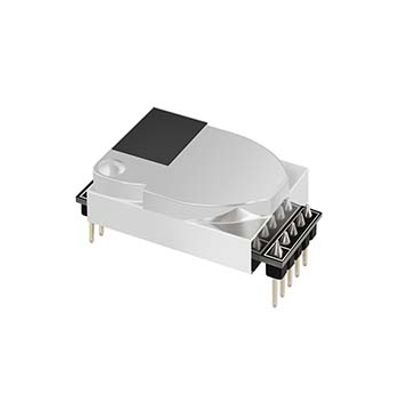
Cubic - Model CM1106LS -Single Beam NDIR CO2 Sensor
CM1106LS is a single beam NDIR CO2 sensor module, based on non-dispersive infrared (NDIR) technology, which can detect CO2 concentration of indoor air. With high accuracy, high stability, small size, it is widely used for ventilation system, air purifier, air conditioner, HVAC transmitter, IAQ monitor, etc.- NDIR technology with independent intellectual property
- High accuracy, long term stability, long lifespan (>10 years)
- Temperature calibration within whole measurement range
- Auto-calibration, no need of maintenance
- Signal output PWM/UART/I²C
- Small size and compact structure, easy to install
- Measurement range: 0~5000ppm default
- Response time: ≤30s
- Accuracy: ±(50ppm+3% of reading) @0℃~50℃, 50±10%RH (Note 1 and 2)
- Working temperature: -10℃~50℃
- Working humidity: 0~95%RH(non-condensing))
- Power supply: DC 4.5V-5.5V
- Ripple wave: <50mV
- Working current: Average≤35mA @ 1s
- Signal output: UART_TTL,I2C (reserved)
- Dimensions: W39.3*H19.7*D9.1(mm)
- Weight: 6g
- Life span: ≥10 years
- Working current: <50mA
Note 1: In normal IAQ applications, accuracy is defined after minimum three (3) ABC periods of continuous operation with ABC on. Some industrial applications do require maintenance. Contact Cubic for further information.
Note 2: Specification is referenced to certified calibration mixtures. Uncertainty of calibration gas mixtures (±2% currently) is to be added to the specified accuracy for absolute measurement.
Fresh Air System
With the rapidurbanization process, the problem of energy consumption has become more andmore serious.Among them, building energy consumption is one of the largestenergy consumptions.
Fresh Air System Controller
For the purpose of achieving energy saving and comfort environment, and with wide spread of internet+ and IoT, especially CO2 and particle sensors development, HVAC system is developing very fast.
Air Quality Monitor
With the improvement of people's living standards, more and more people begin to pay attention to the air quality of their living environment.
Household & Central Air Conditioner
With the continuous upgrading of home appliances, the all-in-one fresh air air conditioner, which integrates air conditioning, purification, and fresh air functions, has gradually become a new fashion.
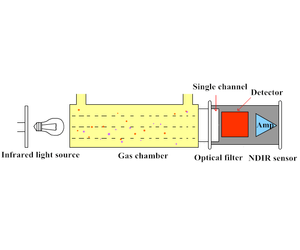
The principle of non-dispersive infrared gas sensing technology is that the gas absorption of characteristic infrared wavelengths conforms to Lambert-Beer's law. The basic principle is that an infrared light source emits an infrared beam through the sampling gas chamber, and each gas component in the sample gas absorbs a specific frequency infrared rays. By the detector to receive and measure the infrared absorption of the corresponding frequency, combined with the algorithm analysis set in the embedded software, the concentration of the gas component can be measured. The reason why this technique is non-dispersive is that the wavelength passing through the sampling gas cell is not pre-filtered.
Different gases have their own different absorption spectra due to differences in their molecular structure, concentration and energy distribution. If the absorption peaks of different gases overlap, the mutual interference between these gases must be dealt with. In addition, in a specific wavelength range, gas detection will also be interfered by moisture. Therefore, the use of non-dispersive infrared technology for gas measurement needs to solve the problems of cross interference between different gases, high and low temperature effects, humidity effects, and component noise effects. This requires the integration of gas path, circuit, optical path design and software algorithm Cooperate.
Compared with electrochemistry,catalytic combustion, solid electrolyte, semiconductor, and photo acoustic methods, the NDIR detection method has the following advantages:
Good selectivity, not susceptible to poisoning and aging due to harmful gases, fast response speed and good stability, low cost, high signal-to-noise ratio, etc.