
Cubic - Model CM1107NS -Dual Beam NDIR CO2 Sensor
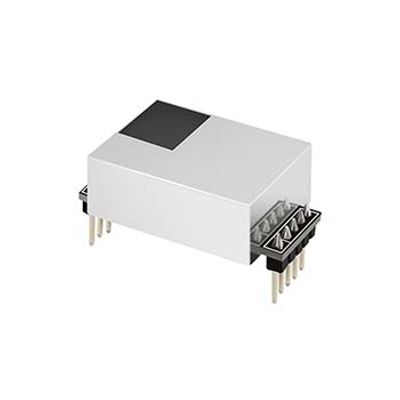
CM1107NS is a dual beam (single light source, dual channel) NDIR CO 2 sensor, based on non-dispersive infrared (NDIR) technology, which can detect CO 2 concentration of indoor air. With higher accuracy, superior long term stability, it is widely used for ventilation system, air purifier, air conditioner, intelligent agriculture, storage and cold-chain, etc- NDIR technology with independent intellectual property
- Dual beam detection for superior stability and better accuracy
- High accuracy, long term stability, long lifespan (>10years)
- Wide range measurement range 0-10000ppm
- Temperature calibration within whole measurement range
- Signal output PWM/UART/I 2 C
- Small size and compact structure, easy to install
- Measurement range: 0~10000ppm default
- Response time: ≤30s
- Accuracy: ±(30ppm+3% of reading) (0℃~50℃, 0-5000ppm, 50±10%RH)
- Working temperature: -10℃~50℃
- Working humidity: 0~95% RH(non-condensing)
- Power supply: DC 4.5V-5.5V; ripplewave <50mV
- Working current Average: <50mA@1s
- Signal output: UART_TTL (3.3V/5V electrical level), PWM, I²C(3.3V electrical level)
- Dimension: W33*H21.7*D12.7(mm)(without pin)
- Weight: 6.3g
- Air Purifier
- Fresh Air System
- Fresh Air System Controller
- Household & Central Air Conditioner
- Greenhouse
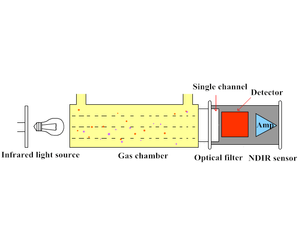
The principle of non-dispersive infrared gas sensing technology is that the gas absorption of characteristic infrared wavelengths conforms to Lambert-Beer's law. The basic principle is that an infrared light source emits an infrared beam through the sampling gas chamber, and each gas component in the sample gas absorbs a specific frequency infrared rays. By the detector to receive and measure the infrared absorption of the corresponding frequency, combined with the algorithm analysis set in the embedded software, the concentration of the gas component can be measured. The reason why this technique is non-dispersive is that the wavelength passing through the sampling gas cell is not pre-filtered.
Different gases have their own different absorption spectra due to differences in their molecular structure, concentration and energy distribution. If the absorption peaks of different gases overlap, the mutual interference between these gases must be dealt with. In addition, in a specific wavelength range, gas detection will also be interfered by moisture. Therefore, the use of non-dispersive infrared technology for gas measurement needs to solve the problems of cross interference between different gases, high and low temperature effects, humidity effects, and component noise effects. This requires the integration of gas path, circuit, optical path design and software algorithm Cooperate.