- Home
- Companies
- D-Opto Optical Dissolved Oxygen Sensors
- Products
- D-Opto - Shutter System
D-Opto - Shutter System
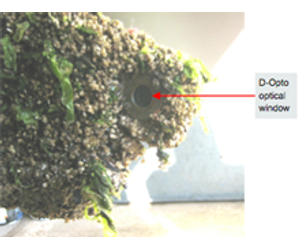
The D-Opto Shutter system has a self-monitoring on-board intelligence that ensures reliable operation of the sensor by covering the the optical window between sampling – opening only when a sample is taken.
When bio-fouling is extreme, the D-Opto shutter protects the sensing window between measurements:
- Prevents bio-fouling and deposits, sediments from accumulating
- Protects the optical window from impact
- For harsh environments
- Fitted to the D-Opto Sensor – the shutter is a mechanical device attaches to the side of the D-Opto
- Controlled by the same data logger attached to the D-Opto.
- Simple to fit,
- Straightforward integration with existing installations
- Power consumption is very low
- Self-monitoring on-board intelligence ensures reliability
The D-Opto Shutter is a mechanical shutter system designed attach to the side of the Zebra-Tech D-Opto optical dissolved oxygen probe.
Between measurements the Shutter disc covers the sensor window to reduce the incidence of bio-fouling and deposits settling and developing.
The Shutter itself incorporates a copper stud, which further discourages the growth of bio-fouling due to the toxic nature of copper. When a measurement is required, the Shutter disc is rotated away from the sensor window, allowing a representative sample of water to come into contact with the D-Opto sensor window. After the measurement has been made, the Shutter closes over the sensor window.
The D-Opto Shutter can be simply controlled by the same data logger that records the output signal from the D-Opto, provided it has a spare programmable control port.
If the data logger control port is set low, the Shutter closes; when the control port is set high, the shutter opens.
The Shutter features a supervisory microprocessor, which constantly monitors the position of the shutter arm, protecting both the D-Opto and the Shutter in the event that debris becomes trapped between the D-Opto and the Shutter.
The Shutter has been designed to operate with minimal power consumption, making it ideal for long term remote deployments with a finite battery supply.