


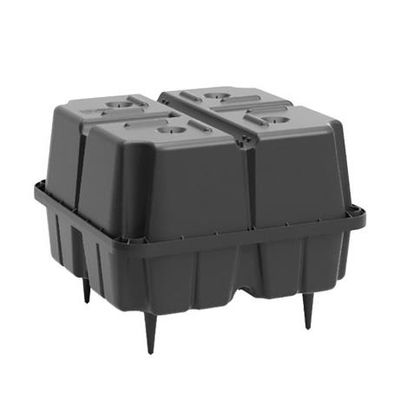
Daliform - Model U-Boot Beton -Lightweight Slab
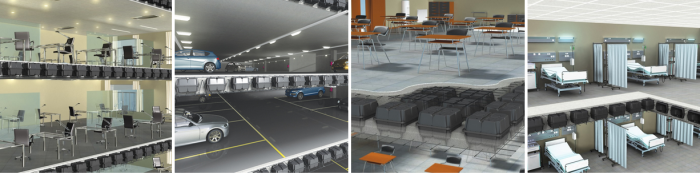
U-Boot® Beton is used to create slabs with large span or that are able to support large loads without beams.
Light and quick and easy to position, thanks to their modularity the designer can vary the geometric parameters as needed to adapt to all situations with great architectural freedom.
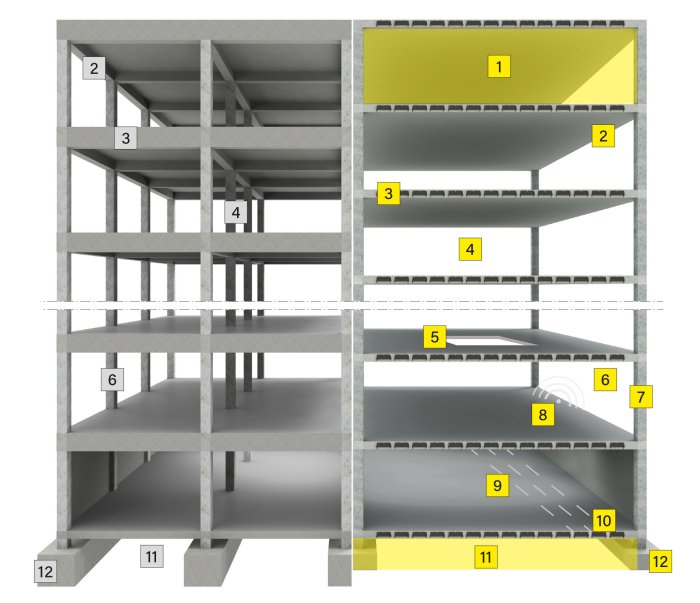
1. INCREASED NUMBER OF FLOORS
Possibility to gain floors at the same building height (towers) and building volume.
2. LACK OF RISING BEAMS
Flat soffit for greater flexibility when installing systems.
3. REDUCED SLAB THICKNESS
Thinner slabs but with equal loads and clearances, or bigger clearances with an equal thickness.
4. LARGE SPAN AND GREAT ARCHITECTURAL FREEDOM
Larger spaces. Less architectural restrictions. Freedom of future reconversion of the environments from an architectural-functional point of view.
5. FLEXIBILITY IN THE REALIZATION OF OPENINGS AFTER THE EXECUTION OF THE SLAB
6. REDUCTION IN THE NUMBER OF PILLARS
Facilitated use reallocation. Wider bays.
7. OPTIMISATION OF THE SECTION OF PILLARS
8. IMPROVED ACOUSTIC BEHAVIOUR
Less acoustic transmittance.
9. POSSIBILITY OF PASSING UTILITIES IN THE THICKNESS OF THE SLAB
10. POSSIBILITY TO USE IT WITH POST-TENSION
11. REDUCED FOUNDATIONS
Lower costs for foundation excavations. Less excavation.
12. REDUCTION IN THE OVERALL LOAD OF THE STRUCTURE WEIGHING ON THE PILLARS AND THE FOUNDATION.
Cheapness of two-way lightened voided slabs U-Boot® Beton system
We are incorrectly led to estimate the advantage of a slab lightened with U-Boot® Beton limiting it to a mere comparison between savings in concrete and the cost of the formwork on the level of the slabs only.
In this way however, as the analysis is immediate and intuitive, it does not account for the various economic, practical and operational advantages provided with U-Boot® Beton for the entire structure: less use of iron in the slabs, pillars and foundation up to a total of 15% (also in the case of variants); less concrete is used not only for the slabs but also for the columns and foundations; there are antiseismic advantages connected to reduced building weight; slimmer pillars and foundations, lower costs related to excavation for foundations; the arrangement, also irregularly if needed, of the pillars to reflect the architectural freedom of the structure. Reduction of work and overhead transfer of the formworks; advantages in on-site logistics.
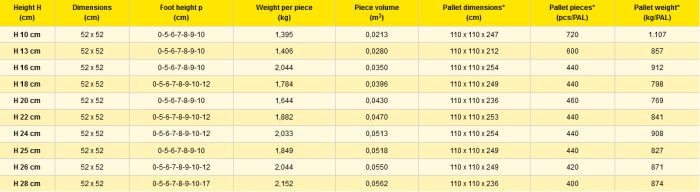
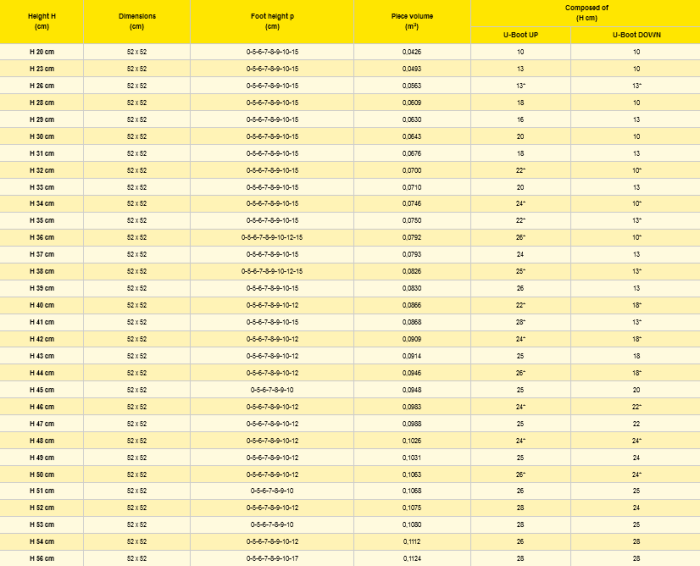
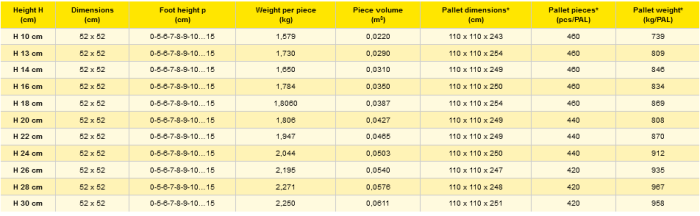
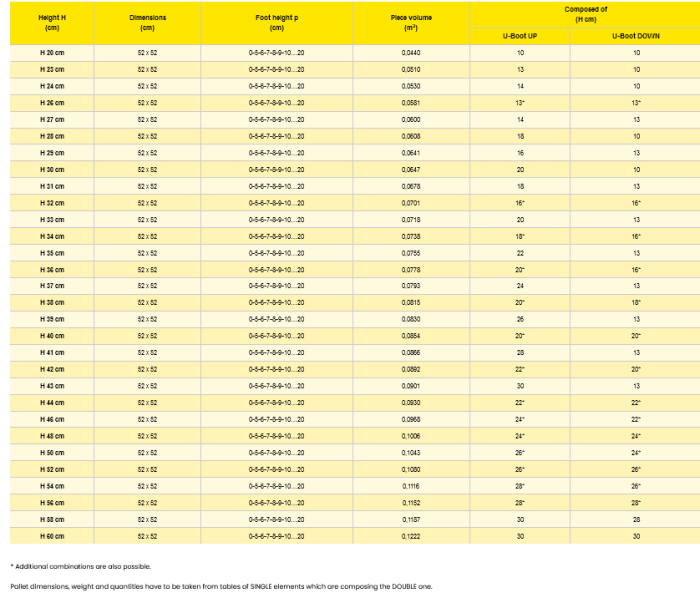
U-Boot® Beton is a recycled polypropylene formwork that was designed to create two-way voided slabs and rafts. The use of
U-Boot® Beton formwork makes it possible to create mushroom pillars, with the possibility to have the mushroom in the thickness of the slab.
Thanks to the conic elevator foot, immerging the U-Boot® Beton formworks in the concrete casting will create a gridwork of mutually perpendicular beams closed from the bottom and the top by a flat plate that is created with a single casting; this results in considerable reduction in the use of concrete and steel.
U-Boot® Beton is used to create slabs with large span or that are able to support large loads without beams.
Light and quick and easy to position, thanks to their modularity the designer can vary the geometric parameters as needed to adapt to all situations with great architectural freedom.
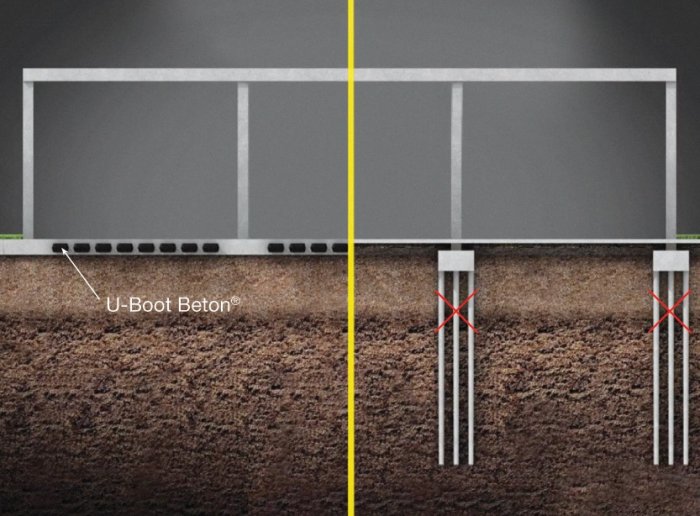
Among the various foundation types, rafts are one of the most well known. They are used above all in ground conditions with little bearing capacity, or with poor quality soil, large thicknesses must be used which increases the construction cost.
Thanks to the use of U-Boot® Beton lightened rafts can be created with the same performance but at a considerably lower cost.
Once drown in the concrete casting, U-Boot® Beton forms the structure just like two full slabs, with a variable thickness, connected by a perpendicular beam gridwork to form a bidirectional static honeycomb plate.
For this concrete bed, the distribution of weights due to hight inertia is rationalised in order to permit maximum stiffness and lightness for the structure with a minimum amount of concrete, which makes it possible to eliminate, where possible, the foundation piles.
CERTIFICATIONS
- Fire Resistance Certificate REI 180 for U-Boot® Beton issued by the CSI institute in Bollate (MI).
- Certification of a Load Test on a sample with U-Boot® Beton issued by the University of Darmstadt.
- Acoustic test according to the standard UNI EN ISO 140-6 – Measurement of acoustic insulation in buildings and building elements; Laboratory measurements of the insulation footstep noise issued by the Istituto Giordano di Gatteo (FC).
- Acoustic test according to the standard UNI EN ISO 140-3 – Measurement of acoustic insulation in buildings; Laboratory measurements of the insulation of air-borne noise from building elements issued by the Istituto Giordano di Gatteo (FC).
- Loading and breaking test certified by the University of Padua.
- Environmental Compatibility Certification (CCA).
The quality of the used mixture, the innovative shape, the thicknesses and dimensions of the product, the fire safety and strict working techniques make it a product of excellence.
U-Boot® Beton, is not subject to deformations, either during or after the casting, either due to the weight of the concrete or the dynamic effect connected to the work operations: it is able to support before casting the workers and fresh concrete, the pressure created during the compression and vibration of the casting, the weight of people, reinforconcretes and equipment guaranteeing conditions of safety, and lack of deformations. Furthermore, the safety of the lateral spacer guarantees its perfect positioning and respect of the geometry of the beams under the pressure of the concrete.
Numerous national and international Product and System Certifications have been received that prove not only product quality, but also the validity of the constructive solutions and the applications in the building industry
All of this, together with the advantages mentioned below, make U-Boot® Beton the product of reference for operators and professionals.
Daliform Group has again demonstrated to be extremely precise with regard to respecting health and the environment having been the first to obtain Environmental Compatibility Certification (CCA) for its products.
This certificate is very important for U-Boot® Beton because it demonstrates: the lack of dangerous substances in its composition (even if recycled materials are used); the lack of emissivity of toxic substances during the various phases of the product’s life and operating cycle, which benefits the health of the intermediate users (production and installation personnel) as well as final users (people living in the building) as well as the environment in general.
- The entire surface of the slab to be cast on site is shuttered with wood deckings (or similar systems), then the lower reinforconcrete bars are positioned in two mutually perpendicular directions according to the design and the lattice for the upper reinforconcrete is arranged.
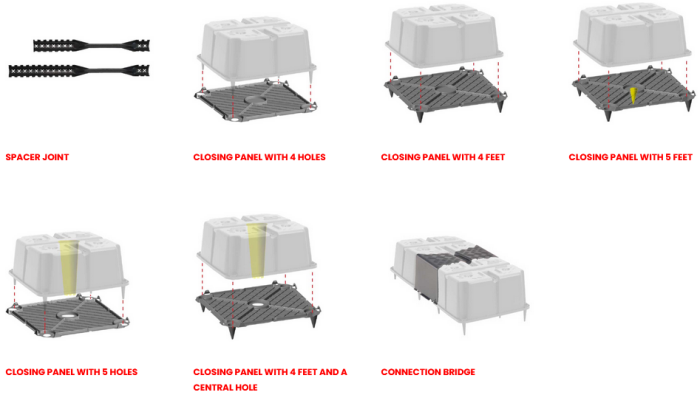
- The U-Boot® Beton formworks are positioned using the lateral spacers joints to place them at the desired centre distance that will determine the beam width. Thanks to the conic elevator foot, the U-Boot® Beton formworks will be lifted from the surface, making it possible for the lower slab to be formed. If double or triple elements are used, these elements must first be assembled, which will be supplied on distinct pallets in the yard.
- The positioning of the reinforconcretes is completed by placing above the U-Boot® Beton formwork the upper bars in the two directions as well as the reinforcement for shear and punching where necessary, according to the design.
- The concrete casting must be performed in two phases to prevent the floatation of the formworks: an initial layer will be cast to fill a thickness equal to the height of the elevator foot. Casting will continue for this first portion of the slab until the concrete starts to set and become semi fluid.
- Once suitably set, the casting can be restarted from the starting point, completely burying the U-Boot® Beton. The casting is then levelled and smoothed in a traditional manner.
- Once the structure has hardened, the formwork can be removed. The surface is smooth in correspondence of the soffit.