


- Home
- Companies
- Delphian Corporation
- Products
- Delphian - Combustible Sensor ...
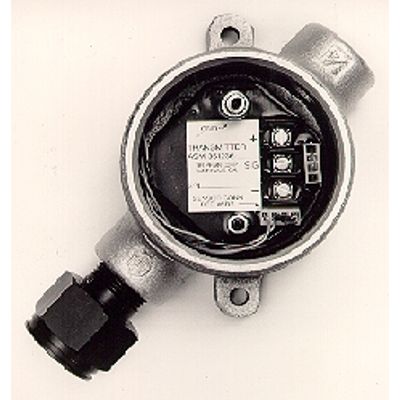
Delphian - Combustible Sensor Transmitters
Delphian`s transmitter is epoxy encapsulated for complete environmental protection and puts sensor power regulation and support electronics where it counts - at the sensor location.
The Delphian transmitter operates the sensor in such a way that changes in gas concentration at the sensor cause linear variations (proportional to the combustible gas concentration) in the signal current output from the transmitter. The sensor is composed of two beads, a reference and an active bead. The transmitter keeps the active bead at constant temperature at all times. When gas is burning on the active bead, it does not need as much electrical energy to maintain its temperature, due to the heat of combustion. The transmitter senses this need, and adjusts the voltage across the bead accordingly.
This current can be scaled by an accessory module (Analog Remote Calibration Module or SafeCAL). When an accessory module is not used, the transmitter will provide approximately 1.0 to 7.0 mA with no gas on the sensor. When a full scale concentration of gas is applied to the sensor, the transmitter will provide a current additional to that already present with no gas. The amount of additional current provided depends upon the age of the sensor and the calibration gas. If the sensor elements fail, the signal current will decrease to below 1.0 mA so that such a failure may be detected.
The signal current is sent to the system control device via a 3-wire cable. This current must be terminated so that the signal remains at least 15 volts below the transmitter "+" terminal when the signal is at the maximum 20 mA. A 250 ohm resistor which is connected from the control devices signal input to ground is the standard form of 4-20 mA termination. Adjustments in the control device should allow the conversion of the current signal from the transmitter into standard gas concentration values. These values can be displayed and used to activate alarms, when appropriate, by the control system. It should be noted that the Delphian micro-controllers require a 1 to 5 mA signal.