

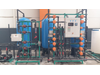
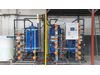
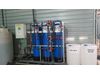
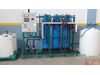
EPA CEVRE - Demineralisation System
Demineralisation Systems involve the removal of all mineral salts (cations and anions) dissolved in water. The resulting water is highly pure and contains almost no minerals. These systems play a vital role in many industrial areas where water quality is critical.
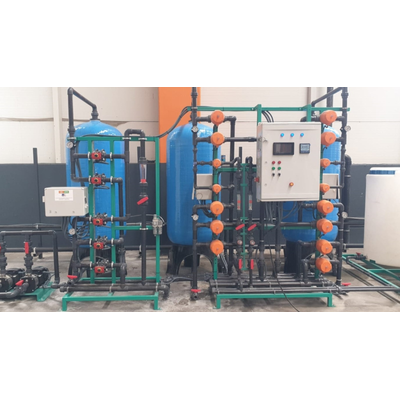
Demineralisation systems are generally based on the principle of ion exchange. In this process, water passes through special resin columns that capture positively charged ions (cations) and negatively charged ions (anions).
- Cation Exchange: In the first stage, water enters a cation exchange resin column. This resin captures positively charged ions such as sodium (Na+), calcium (Ca 2+), and magnesium (Mg 2+), and releases hydrogen (H(+)) ions in their place.
- Anion Exchange: In the second stage, the cation-depleted water is directed to an anion exchange resin column. This resin traps negatively charged ions such as chloride (Cl?), sulphate (SO4²?), and bicarbonate (HCO3?)and releases hydroxide (OH?)ions in their place.
- Neutralisation: As a result, the released hydrogen (H?) and hydroxide (OH?) ions combine to form pure H2O molecules.
Areas of Use
- Steam Boilers: The use of pure water is mandatory in high-pressure steam boilers. Minerals in water cause scaling in pipes, reducing heat transfer efficiency, leading to energy loss and even causing pipe bursts.
- Pharmaceutical and Cosmetics Industry: The use of high-purity water is essential for product quality and stability. Demineralised water ensures that product formulations are not affected by unwanted chemical reactions.
- Electronics Industry: Even the smallest mineral residue can cause circuit failure in semiconductor and microchip production. Therefore, absolutely pure water (deionised water) is used.
- Automotive Sector: Using pure water in battery fluid extends the battery`s lifespan and enhances its performance.
- Laboratories: Mineral-free water is essential for the accuracy of analytical tests.
There are two main demineralisation systems:
- Dual Bed Systems: Cation and anion exchange resins are located in separate columns.
- Mixed Bed Systems: Cation and anion resins are mixed together and used in a single column. These systems are preferred for obtaining higher purity water.
Demineralisation systems are a critical technology that directly affects the efficiency, safety and product quality of industrial processes. Maintenance of these systems and regeneration of the resins must be carried out regularly to maintain optimum performance.