


- Home
- Companies
- Optoplex Corporation
- Products
- Optoplex - Model DQPSK - Demodulator
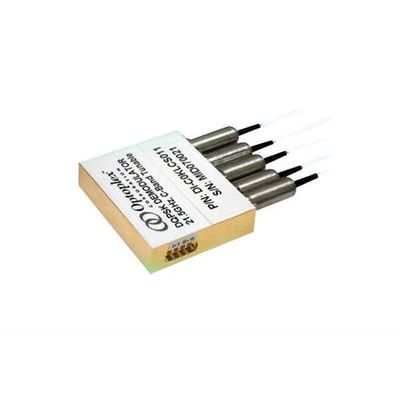
Optoplex - Model DQPSK -Demodulator
Differential Quaternary Phase-Shift Keying (DQPSK) is the four-level version of DPSK. DQPSK transmits two bits for every symbol (bit combinations being 00, 01, 11 and 10) and has an additional advantage over conventional binary DPSK. DQPSK has a narrower optical spectrum, which tolerates more dispersion (both chromatic and polarization-mode), allows for stronger optical filtering, and enables closer channel spacing. As a result, DQPSK is the only modulation format which allows processing of 40Gb/s data-rate in a 50-GHz channel spacing system.
With DQPSK, the bandwidth of the drive electronics needs only be half of the bit rate. So 43 Gb/s signals can be generated with 21.5 Gb/s equipment. This allows system providers to achieve the expanded flexibility of reducing system cost by using low-speed drive electronics.
Optoplex`s Optical DQPSK demodulator converts quadratural phase modulation into amplitude modulation over the entire C+L band in support of data transmission rate of 10 or 40 Gb/s. DQPSK demodulator is designed for the next generation optical communications systems utilized in commercial, defense and space exploration markets. The device plays a key role in improving signal quality and performance to meet the expanding demand for higher data rates and more complex transmission formats within current and next generation systems without major capital expenditure.
- DQPSK demodulator uses half the transmission rate to achieve the same data rate (20-Gb/s system for 40-Gb/s data rate, with four phase states instead of two in DPSK format)
- Lower transmission rate saves cost on many other components and electronics and is more tolerate of dispersion
- 20-Gb/s system is the highest transmission rate possible for the 50-GHz channel spacing
- Optoplex’s DQPSK demodulator currently provides a convenient solution for this application by using two matched DPSK demodulators with phase off-set at ± π/4. The co-packaged single-core DQPSK demodulator is also under development
- Athermal design
- C+L band coverage by a single device
- Low temperature-dependent frequency shift (TDFS)
- Low polarization-dependent frequency shift (PDFS)
- Wide bandwidth
- Low insertion loss & PDL
- High power handling
- Passive, semi-tunable and fully tunable operation
- Suitable for both RZ and NRZ modulation format
- Telcordia GR-1221 qualified
- 5 or 20 Gb/s DQPSK Signal Reception
- Data Rate Optimization
- Extend Transmission Distances
- Wavelength Range (C-Band) nm 1527 to 1567
- Wavelength Range (L-Band) nm 1567 to 1607
- Free Spectral Range1 (FSR, ~1/2 of the nominal data rate, a few typical values are given) GHz 10.7, 21.5, 28 or 32.5
- FSR Error2 % < 1
- Insertion Loss2 (including all connectors) dB 5.7 Typical; 6.0 Max
- Extinction Ratio2 dB > 18
- PMD2 ps < 0.1
- Return Loss dB > 40
- PDL2 dB < 0.2
- PDFS2 deg < 3
- Optical Path Delay2 (Skew, among Input -> I1, I2, Q1, Q2) ps < 1.0
- Tuning Range FSR > 1.5
- Tuning Time Constant3 sec < 1.0
- Power Consumption W 1.0 Typical; 2.0 Max
- Tuning Voltage V 0 to 5
- Maximum Input Optical Power mW 300
- Operating Temperature °C -5 to 65
- Storage Temperature °C -40 to 85
- Dimension (L x W x H)4 mm 50x41x11
- Connector Type - TBD
- Fiber Pigtail Type - SMF-28 with 900 µm loose tube
- Fiber pigtail length m 1.0 ± 0