

PSL Systemtechnik GmbH
PSL Systemtechnik - Differential Dynamic Scale Loop
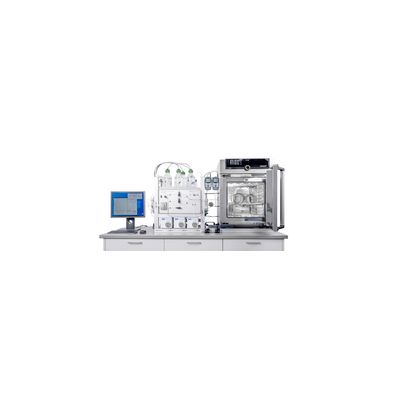
The Differential Dynamic Scale Loop (DSL) by PSL Systemtechnik is an automated laboratory instrument designed for testing and examining the formation of scale and other salts in pipelines. Originally conceptualized for the petrochemical and oil industries, this equipment simulates realistic pipeline conditions with temperatures up to 300°C (572°F) and pressures up to 400 bar (5,800 psi). This makes it ideal for evaluating the effectiveness of scale inhibitors, antiscalants, and scale removers across various aqueous solutions including carbonate, sulphate, and salt deposits. The system uses three HPLC pumps to mix anionic and cationic solutions with a known concentration of inhibitor, allowing for stepwise adjustments and precise monitoring of sedimentation through differential pressure measurements. The model pipeline is versatile, offering different lengths and diameters to simulate various test conditions, and is primarily constructed from stainless steel. The fully automated software, WinDSL, enables complex test sequences and thorough cleaning procedures, facilitating unsupervised overnight runs and long-term experiments. The instrument is adaptable to specific requirements, ensuring its suitability for a wide range of industrial applications.Most popular related searches
differential pressure monitoring
water treatment additive
laboratory automation system
scaling control
scale remover
scaling inhibitor
laboratory automation
water pipeline
pipeline condition
scaling formation
The Differential Dynamic Scale Loop by PSL Systemtechnik as a fully automated laboratory device is a tube blocking system to examine the precipitation and deposition of scale and other salt crystals in pipework systems such as oil pipelines or water pipes, industrial plants or heat exchangers. This device is used to test scale inhibitors, antiscalants or scale removers. The Differential Dynamic Scale Loop simulates the conditions in pipelines and production systems at temperatures up to 300 °C / 572 °F and pressures up to 400 bar / 5,800 psi. It can be used for all aqueous solutions with crystalline deposits, e.g. carbonate, sulphate, iron and other deposits, sugar, salt from seawater and geothermal water.