


- Home
- Companies
- NETZSCH Group
- Products
- DSC Caliris Classic - Model 300 - ...
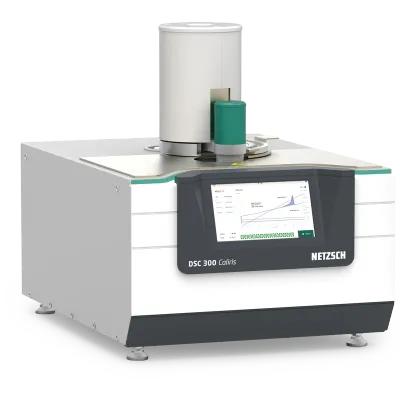
DSC Caliris Classic - Model 300 -Differential scanning calorimetry
The DSC Caliris® Classic is a robust instrument with attractive price-performance ratio. Easy-to-use, compact, robust, precise, optimized for everyday use – these are the features of the innovative DSC 300 Caliris® Classic . The unique design of this instrument encompasses everything needed for successful DSC investigations – regardless of whether the user is a beginner or an experienced professional. Above all, it is the innovative software that sets new standards: the already established AutoEvaluation and Identify now meet the next generation of data management LabV®, which keeps track of the collected data and organizes it for a smooth laboratory workflow.
The DSC 300 Caliris®Classic offers:
- a compact design for more space in your lab
- smart software that allows you to get started quickly with DSC measurements
- automated measurement and evaluation, making routine easy
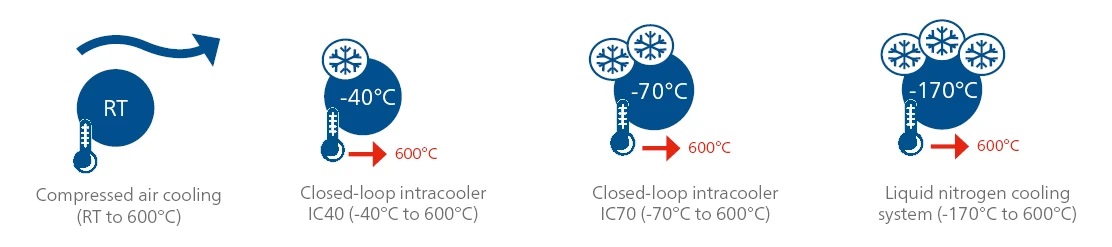
- various cooling systems:
NETZSCH’s Unlimited Warranty
At NETZSCH, our commitment to quality goes beyond the instruments themselves. We understand that your investment in advanced technology is a long-term one, and and that’s why we offer something truly unique – our Unlimited Warranty.
With laboratory space often at a premium, the compact design of the DSC 300 Caliris® Classic with cooling accessories such as the intracooler makes it an excellent choice. It is perfect for at-line testing and can be easily set up in a production environment for QA/QC purposes.
In addition to the conventional display, the DSC 300 Caliris® Classic also offers an optional integrated touchscreen display that provides detailed instrument and measurement information.
Once a measurement has been prepared using the Proteus® software, it can be started directly from the touch display. When a measurement is in progress, the touch display provides up-to-the-minute measurement information without the need to access your PC.
The monolithic DSC sensor is stable in harsh environments and provides optimal resolution. The sensor disks and thermocouple wires are laser-welded for high sensitivity and ruggedness. This is further emphasized by the fact that the sensor can be cleaned with a glass fiber brush. In the event of unwanted contamination of the cell or sensor, the temperature range of up to 600°C allows easy cleaning by baking out the contaminants. In addition, cleverly designed connectors allow quick and easy installation of various cooling systems.
Differential Scanning Calorimetry (DSC) / Differential Thermal Analysis (DTA)
Differential scanning calorimetry (DSC) is most frequently used thermoanalytical method to determine EndothermicA sample transition or a reaction is endothermic if heat is needed for the conversion.endothermic and ExothermicA sample transition or a reaction is exothermic if heat is generated.exothermic transitions like the determination of transformation temperatures and enthalpy of solids and liquids. It measures the difference between the heat flow rate into a sample versus into a reference as a function of temperature/time.
DSC is widely used in various fields such as polymer science, pharmaceuticals, food and cosmetics, organics and inorganics. It provides critical information about material properties like melting points, CrystallizationCrystallization is the physical process of hardening during the formation and growth of crystals. During this process, heat of crystallization is released.crystallization temperatures, Phase TransitionsThe term phase transition (or phase change) is most commonly used to describe transitions between the solid, liquid and gaseous states.phase transitions and purity.
Temperature range
-170°C to 600°C
Automatic Sample Changer
For up to 20 samples and references
Heating/Cooling rate
0.001 K/min to 100 K/min
Enthalpy precision:
± 0.1% for indium
Specific heat determination: Optional
Temperature modulation: Optional
Gas atmospheres:
Inert, oxidizing, static and dynamic operation
Automatic Sample Changer (ASC):
Up to 20 samples and references, optional
Cooling device options:
Compressed air cooling (RT to 600°C)
IC40 (-40 °C to 600°C)
IC70 (-70°C to 600°C)
LN2 (-170°C to 600°C)
Indium Response Ratio:
> 100 mW/K
(Mean value, related to indium as standard material under measurement conditions typically used for polymer investigation)
Heating/Cooling rate:
0.001 K/min to 100 K/min
(Maximum rate depends on temperature)