


LandScan, LLC
- Home
- Companies
- LandScan, LLC
- Products
- Digital Vegetation Signature
Digital Vegetation Signature
FromLandScan, LLC
There is more to airborne remote sensing than meets the eye. Unlike satellite data, imagery collected with airplanes or drones is not calibrated. Most providers will say they calibrate their airborne spectral imagery, but it is not calibrated at the pixel-scale which is important in order to generate analytical quality data in space and time. In addition to high-resolution spectral calibration, LandScan has added a thermal and a hyper-spatial calibration process.
Most popular related searches
remote sensing
airborne remote sensing
LiDAR sensor
satellite data
contaminant analysis
contamination analysis
satellite image
LiDAR
water conditioning
The Digital Vegetation Signature (DVS) technology can distinguish any two plants from one another and generate rapid, unique digital classifications based on spectral, thermal, and hyper-spatial characteristics. The DVS is generated using a system of software, hardware, and analytics and can be applied to both drone and airplane sensing platforms. The DVS is analytical quality remote sensing.
What isn’t well-calibrated can’t be quantified with accuracy or certainty. This is particularly so when analyzing crop performance over time. Do not be fooled by airborne imagery describing cumulative conditions like water or nutrient stress which are not produced with imagery calibrated at the pixel scale; the noise and uncertainty will accumulate with time.
One of the most important benefits of remote sensing calibration is that it enables LandScan to deploy the DVS over large areas. LandScan deployed a drone-based LIDAR sensor in-line (same day) with our hyper-spatial analytics to enable comparison of the two. The DVS sensor covers 10x more ground but is able to deliver a similar level of 3D resolution. This data provides a rapid, objective and repeatable measure of plant performance and behavior.
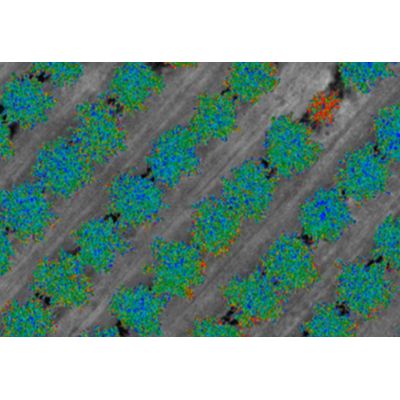
Calibration enables the study of individual plants and their immediate surrounding as individual objects for analytical purposes. This image shows how the DVS product can be tuned to filter out vegetation within a certain height of the ground, thus prohibiting cover crop from contaminating the analysis of the tree. Another filter removes the dead branches while yet another selects only sunlit pixels, so that all pixels used to characterize the tree are consistently lighted and thus comparable over time (still other DVS calibrations account for changes in atmospheric conditions).
There are dozens of such algorithms in the DVS software. All of this is only possible because the DVS data is analytical quality. Only with calibrated data can you perform temporal analytics.