


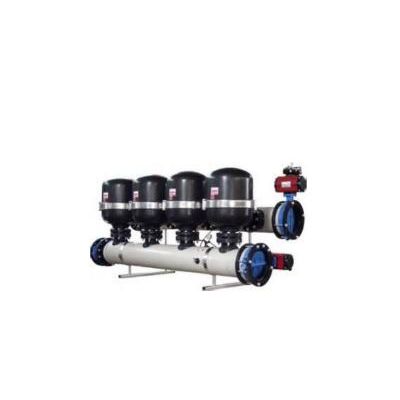
Disc Filters
The Amiad range of disc filters comprises sets of plastic discs stacked onto a hollow spring loaded spine. The raw water passes through the discs from the outside to the inside, trapping suspended solids between the layers as it does so. Multiple disc filter ‘pods’ can be supplied on pre-made manifolds, in what is known as ‘batteries’, to allow large flow rates.
The design of the grooves on the discs means that the filtration is ‘multiple pass’ – in other words, the water passes through several spaces of the filtration size before it reaches the spine, giving several chances for particle capture, unlike screen filters which present one pass only.
Backwashing can be done in one of three ways: using the forwards flow of the process, passing through a secondary second filter first; using a separate external pump; or, by using air from an external compressor to drive the backwash water, reducing backwash time to <10 seconds and regulating water volume used.
When arranged in a battery, only one module washes at a time, ensuring minimal to zero change in downstream water flow.
The Filtering Process
Raw water enters the filter housing and passes through the stack of discs to the hollow spline, and from there exits the filter. Suspended particles in the water are trapped by the discs. A spring on the spine holds the discs clamped together to ensure the degree of filtration is achieved. Forwards water pressure assists this spring.
The filtering process is monitored on each module by a pressure differential switch, which will automatically trigger backwashing of the module once the preset pressure differential has been passed.
The Cleaning Process
Cleaning of the filter is initiated by the control system, activated by pressure differential, time or manually. Upon activation, the valve configuration at the base of the module closes raw water to the inlet, and filtered water to the outlet, then connects the inlet to a waste drain.
Backwash water from one of the sources outlined below is then connected to the outlet. The pressure of this water entering the spine causes the spring loaded part to lift, releasing the clamping pressure on the discs, allowing them to separate.
The spline also has directional jets on it; these jets cause the discs to spin, releasing any dirt particles attached to them. Due to their design and the design of the spline, the discs do not contact the spine while they are spinning, ensuring no wear and a long lifetime.
The module is then returned to forwards flow
In the case of a battery, this process is then repeated for the other modules.