

DLC Coating
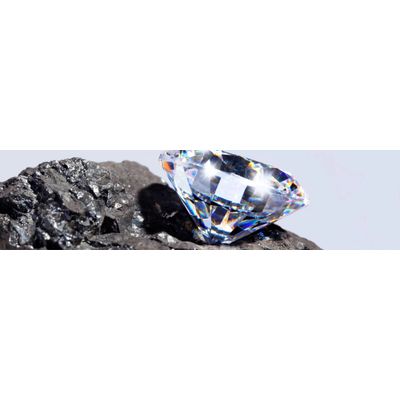
Introducing the New Standard for DLC (Diamond-Like Carbon) Coatings: CertessTM Carbon. What is a Diamond-Like Carbon (DLC) Coating? In recent years, a new generation of PVD + PACVD (plasma-assisted CVD) carbon has gained widespread commercial success. Carbon can exist in three allotropic forms: In a diamond crystal structure, it is one of the hardest known materials. In a graphite crystal structure, is very soft and lubricous. Diamond-like carbon (DLC) coatings combine the properties of diamond and graphite: high hardness levels, in the range of conventional tribological PVD coatings (1500 - 3200 HV), coupled with a coefficient of friction which is 200-500% lower than that of conventional PVD coatings. (See illustration below.)
As part of the HEF Group, TS NCT offers a wide variety of DLC coatings for our customers to choose from, with properties and underlayers that can be adjusted to provide the optimum performance for your application.
Coating hardness can vary depending on the structure of the coating. The ratio of SP2 to SP3 bonding and hydrogen content can vary in the film depending on the process used to deposit the DLC coating and the process parameters. The phase diagram to the right shows the various groups or regions for DLC coatings that are available:
- Films with higher SP2 bonding, or graphitic content, will exhibit lower film hardness and tend to provide lower abrasion-resistance.
- Films with a very high SP3 bonding content will tend to be very hard with a high level of abrasion-resistance, but will be brittle and less ductile.
- Films with very high SP3 content and no hydrogen are tetrahedral DLC (ta-C) coatings, exhibiting a very high surface hardness of 3000 - 7000 Hv, but offer low ductility.
All DLC coatings will have multiple bonds and varying hydrogen content within the coating. Depositing a film that combines the proper amount of hydrogen, the proper ratio of SP2 to SP3 bonding, and the best underlayer for the application is key to achieving low friction, a high level of wear-resistance, ductility, and proper adhesion and load-carrying capability.
We work with customers to understand the wear modes and operating conditions of your component to select the best DLC coating for your application.
The properties of DLC coatings (hardness, coefficient of friction, roughness, adhesion level, load-carrying capacity, resistance to humidity-influenced degradation, fatigue tolerance, etc.) can be tailored over a wide range depending upon deposition parameters, deposition technology, and the combination of materials constituting the coating. While the layers can be varied to meet the application requirements, the image below shows a normal transition and layering from the substrate to the DLC layer.
In order to meet the diverse operating conditions encountered by engineered components used for automotive and other industrial applications, HEF has developed a family of DLC coatings. These coatings usually include several layers of different materials, such as Cr, CrN, W, WC-C, and Si, with a top layer of amorphous carbon and hydrogen. The selection of the under layer is based upon several factors such as: adhesion requirements, wear mode and contact mode, friction regimes encountered during operation, load-carrying capacity, and other metallurgical considerations. These coatings have a unique combination of high hardness and low friction coefficient compared to conventional PVD coating (TiN, CrN, ALTiN, etc.) and soft coatings (including solid lubricants like Molybdenum di-sulfide).
- Unique combination of high hardness and low friction coefficient produces the hardness of diamond and the lubricity of graphite
Our Multistep Sputtering and PACVD CertessTM Carbon DLC Process Enables Coating Properties to be Tailored to Provide Key Product Attributes
DLC (Diamond-Like Carbon) Coating involves a multistep process:
- Precleaning
- Placement of parts in a planetary fixture using single-, double- or triple-axis rotation
- Pump-down under vacuum
- Low-temperature preheating process
- Ion Bombardment
- Underlayer deposition (PVD process)
- Amorphous carbon layer deposition
- Cooling
Precleaning, Fixturing, Pump-down
After going through a multistep pre-cleaning process, the parts are placed on a planetary fixture capable of single, double or triple-axis rotation. The planetary fixture is then placed into the vacuum chamber and the chamber is evacuated and put under vacuum.
Preheating & Ion Bombardment
After the chamber reaches the preset vacuum level, low-temperature preheating begins. Next the product is bombarded with ions of argon gas to scrub or sputter-clean the surface and remove micro-oxides and micro-contamination. This scrubbing of the surface improves the adhesion of the coating to the substrate.
Underlayer Deposition (PVD Coating)
The first step in the coating process is to deposit an underlayer using a high-energy PVD sputtering process developed by the HEF Group to deposit a dense, well adhered, smooth under layer.
The DLC coatings will usually include several layers of different materials as an underlayer, such as Cr, CrN, W, WC-C or Si, with a top layer of amorphous carbon, with hydrogen. The selection of the underlayer is based upon several factors, such as: adhesion requirements, wear and contact modes, friction regimes encountered during operation, load-carrying capacity, and other metallurgical considerations.
Amorphous Carbon DLC DepositionAs the underlayer coating reaches the proper thickness, the process transitions into the DLC coating step which deposits a dense, smooth, amorphous carbon hydrogenated (a-C:H) layer onto the product’s surface. The amorphous carbon DLC layer has the unique combination of high hardness and low friction coefficient, yielding the hardness of diamond and the lubricity of graphite. The properties can be tailored to an application depending on:
- Deposition technology & parameters
- Alloying elements
- Coating architecture (single, multilayered, or graded)