


- Home
- Companies
- Droplet Measurement Technologies (DMT)
- Products
- DMT - Model BCP - Back-Scatter Cloud ...
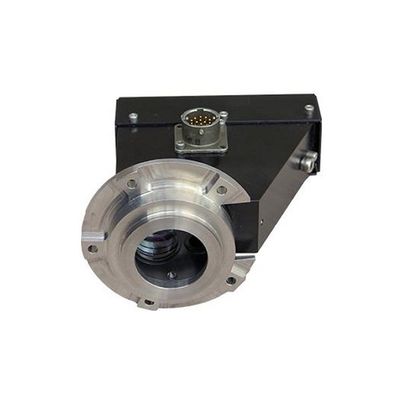
DMT - Model BCP -Back-Scatter Cloud Probe
The BCP is a compact probe that measures 5 µm to 75 µm particles with no contamination from ice crystal shattering and no airflow distortion.
Minimize airflow disturbance and enable undisturbed particle measurement with the BCP’s aerodynamic design. Mount the BCP easily on aircraft, even when space is at a premium.
Monitor multiple output variables like total particles, average transit time, over-range particles, and various probe health indicators.
Depend on automatic adjustments to both sizer and qualifier signals to account for temperature drifts and ensure accurate particle sizing.
Program the instrument`s sample rate and size bin thresholds. Plus, get size distributions accumulated in the probe, with serial transmission to a computer via any standard RS-232 or RS-422 communications port.
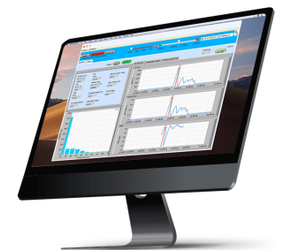
BCP utilizes optional PADS software that provides a user-friendly virtual instrument panel. PADS allows the user to control the BCP and display real-time data and logs. For instance, the program enables the user to do the following tasks:
- Start data recording and sampling
- View a size histogram of particles measured by the BCP
- View particle volume and number concentrations, as well as Liquid Water Content (LWC), Median Volume Diameter (MVD) and Effective Diameter (ED)
- Monitor instrument operational parameters like optic block temperature, electronic box temperature, and the baseline monitor voltage
- Cloud Physics Research
- Climate Models & Radiative Forcing
Particle light-scattering
- Particles passing through the laser beam scatter light in all directions.
- Light transmitted within a cone with subtending angles between 143° and 169° (156° ± 13°) is directed onto a photodetector that converts photon pulses into electrical pulses, which are then transmitted to a signal processor that amplifies and digitizes them.
- Mie theory is used to determine the particle’s size from the peak amplitude of the scattering signal, then used to determine particle number concentration.
- Measured Parameters : Single-particle light scattering
- Auxiliary Parameters : Temperature Pressure
- Derived Parameters
- Particle diameter
- Particle number concentration
- Liquid water content (LWC)
- Effective Diameter (ED)
- Median volume diameter (MVD)
- Particle Size Range : 5 - 75 µm
- Number of Size Bins
- 10, 20, 30, or 40 (configured at time of purchase)
- User-Selected boundaries
- Number of Concentration Range : 0 - 1,000 particles/cm3
- Air Speed Range : 10 - 250 m/sec
- Sampling Frequency : Selectable, .04 sec to 20 sec
- Light Collection Angles : Center-line: 156°, +/- 13° (see "How it Works" diagram)
- Laser : 658 nm
- Laser Power : 50 mW or less
- Data System Interface : RS-422 serial interface
- Environmental Operating Conditions:
- Temperature: -40° to 40°C
- Relative Humidity: 0 - 100%, non-condensing
- Altitude: 0 - 50,000 feet (0 - 15,000 meters)
- Weight : 1.5 kg
- Probe Dimensions : 11.7 cm x 10.7 cm x 4.5 cm, with 5.9 cm diameter mounting flange
- Electronic Box Dimensions : 21.6 cm x 12 cm x 5.7 cm
- Power Requirements : 28 VDC, 5 A for system and heaters
The Lifecycle Care Program ensures BCP integrity and performance vital to your research mission for 3 years or 3 calls (whichever comes first). When conducting complex and time intensive laboratory or field measurements it is critical to avoid down time, and ensure data collection accuracy. The program consists of 3 key deliverables for each year or call:
- Instrument Logistics
- Instrument Integrity
- Instrument Performance
Lifecycle Care Program Includes:
LOGISTICS
- Shipping to and from Droplet Measurement Technologies facility
- Customs handling, including CARNET ATA if required
INTEGRITY
- Incoming instrument evaluation and health check
PERFORMANCE
- Software and firmware validation
- 100%-unit functionality test
- Calibration data
- Calibration report
- Certificate of calibration
At times, our technician might discover an instrument issue, which might not be covered by the Lifecycle Care Program or by our product warranty. In such case we will reach out to you with a service & repair estimate to allow you to provide us with the next steps of action.