


- Home
- Companies
- Hydro-Vacuum S.A.
- Products
- Hydro-Vacuum - Model PSEeko - Domestic ...
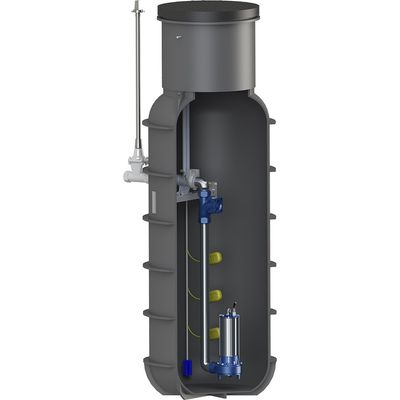
Hydro-Vacuum - Model PSEeko -Domestic Sewage Pumping Stations
The PSE.1 eko sewage pumping stations are complete, fully automated devices. Materials used to construct the pumping stations guarantee complete tightness of the structure and its long-term lifespan thanks to, e.g., the ensured corrosion resistance.
Domestic sewage pumping stations are used in mixed or gravitational and pressure sewage systems used to drain rainwater and household sewage from single- and multi-family houses and public utility buildings.
The PSE.1 eko sewage pumping station made by Hydro-Vacuum S.A., the leading Polish manufacturer of pumps and pumping systems, by standard contains a PEHD tank of 800 mm diameter and height adapted to investment needs in the range from 2250 to 2800 mm. The hydraulic system of the pumping station is composed of discharge pipelines made of 1.4301 grade stainless steel of DN50 diameter, a non-return, ball valve, as well as a ZSP.1 pump coupling set with guides. The guides are elements that distinguish our pumping stations from domestic pumping stations of other manufacturers. They significantly facilitate use and allow for installing and dismantling the pump from ground level.
A TS sewage pumping station is a complete, fully automated device that consists of the following components:
- collector tank,
- separation tank,
- two separators - bar basket, flaps,
- two pumps with a high-efficiency channel impeller,
- hydraulic equipment elements, i.e. flanges, T-connectors, elbows, SHUSTER system ball check valves, connectors, knife gate, etc.,
- ultrasound level gauge,
- safety and control device.
The sewage pumping station tank, depending on the size type, is made entirely of austenite steel or austenite steel and plastic. Separators, flanges, T-connectors and connecting elements are made of austenite steel of high corrosion resistance to sewage effects. The structure and materials of other elements of hydraulic equipment (check valves, gates, pumps) make them resistant to sewage effects. In construction of sewage pumping stations were used SZUSTER check valves that ensure reliable and effective transport of sewage containing solids on the stretch gravitational collector - separators.
The valve ball (when fully open) tightly closes the bent valve duct, which ensures :
- very high resistance of the valve to solid pollutions, because during flow the valve works like a regular elbow,
- free clearance for solids, from the flow speed of 0.7 m/s, without causing vibrations of the ball, which is impossible to achieve with classic valve constructions.
The structure of the sewage pumping station was designed so that access to its basic elements (pump, separators) for conducting repair or service work could be possible without the need to break its operation.
The structure of the sewage pumping station was designed so that access to its basic elements (pump, separators) for conducting repair or service work could be possible without the need to break its operation. The sewage pumping station is equipped with two FZB pumps working alternatively, with a high-efficiency hydraulic system and a movement-durable drive transmission. Because for driving FZB pumps were used classic high-efficiency electric motors with fan cooling and an additional separation oil chamber was used between the pump and the driving motor, operation values of these pump machines could be improved.
In the classic (wet) pumping station, sewage supplied through a gravitation duct flow directly into a retention tank. In pumping stations with separation of solids, sewage flows into a pumping station housed in a dry chamber, then distributed into individual separators. From separators, partly treated sewage, without solids, sediments and dragged elements flows gravitationally through hydraulic elements of pumps into the pumping station`s tank. In the case when any of the pump is working, sewage flows only into the separator connected with the idle pump. Preset sewage levels in the station’s tank are controlled with an ultrasound gauge (optional use of other types of sensors). The safety and control device, after receiving a signal that preset sewage levels in the tank have been achieved, activates or stops proper appropriate pumps. The activated pump sucks in partly treated sewage and forces it into the separator located on the axis of the pressure switch of the pump. The energy of the stream of sewage being pumped carries solids from the separator and takes them to the pressure pipeline of the pumping station. Excess pressure produced during pumping closes back flow of sewage into the station’s tank. During the pump`s working cycle, sewage flows into the tank through the second separator and hydraulic system of the idle pump. After achieving the lower preset sewage level in the tank, the pump switches off automatically. The separator`s construction (a special rod cage system) enables the pumping station to work in a constant way that does not require the implementation of additional operations of removing accumulated impurities. During every start of the pump, the separator performs a `self-cleaning` procedure. The hydraulic system of the pumps, which does not have direct contact with solids, and especially dragged materials, is not exposed to clogging.
- modern constructional solutions
- integrated construction of the tank with equipment delivered as a complete product
- guarantee of long-term reliable operation
- easy and quick installation of the pumping station in every ground and water conditions, minimising ground and installation works
- automated operation of the device
- possibility to flush discharge pipelines through installation of a fireman coupling
- energy-saving motors, also available in EX explosion-proof version
- low investment and operation costs
- constant technical supervision and guarantee and post-guarantee technical support
- unlimited availability of spare parts
- high efficiency and long-term lifespan in particularly difficult operating conditions
- the diameter and angle of the inlet connection adapted to the client’s needs
- GSM notifications
- Tank material: PEHD
- Tank diameter: 800mm / 1000mm
- Tank height: 2500 - 2800mm
- Pump types: FZR.1, FZX.1, FZY.1, FZV.1
- Pump power: 1,50 – 3,0kW
- Discharge riser pipe diameter: DN50
- Control panel: UZS.4