


- Home
- Companies
- R3 Environmental Systems
- Products
- Drilling Fluid Recovery
Drilling Fluid Recovery
The Vacuum Assisted Pure Oil Recovery technology helps reduce the carbon footprint and other environmental impacts of oil and gas exploration and production. The high quality of the drilling fluid recovered when using the technology means the recovered fluid can be used as a direct substitute for virgin drilling fluid in the formulation of new drilling mud products. As a result, companies can significantly reduce the amount of virgin drilling fluid they need to purchase, transport, and eventually dispose of.
Recovering and reusing the base drilling fluid instead of using new drilling fluid is an opportunity for the industry to meaning fully reduce greenhouse gas emissions while maintaining quality standards. The quality of the recovered drilling fluid has been independently evaluated by a third-party engineering firm and the Chemical Abstract Service, a division of the American Chemical Society, both of which found the fluid to be equivalent to the virgin drilling fluid. As a result of this evaluation, the recovered drilling fluid, which we market as SecondSource drilling fluid, has been assigned the same CAS number as the original base drilling fluid.
Due to the environmentally sensitive nature of oil and gas exploration and production, and the growing need to drill through difficult formations, companies are being forced to use advanced drilling techniques that utilize high-performance drilling fluids. These high-performance drilling fluids are typically comprised of low-toxicity mineral oil (LTMO) or synthetic oil that contains hydrocarbon molecules in the C10–C24 range. Although these fluids are generally less toxic and less persistent in the environment, they are extremely expensive when compared to the traditional diesel-based drilling fluids.
When an oil or gas well is drilled into a formation containing hydrocarbons, the drilling process generates drill cuttings which are washed back to the surface by the circulation of drilling mud in the well. The drill cuttings are usually contaminated by hydrocarbons from the reservoir and by the drilling mud that is pumped into the well. The contamination of the cuttings presents challenges for the operator as environmental regulations require the cuttings be treated to reduce the residual hydrocarbon content to acceptable levels before they can be safely disposed of. Recovering the used drilling mud for subsequent use in future drilling events and cycles is both more environmentally conscious and less costly
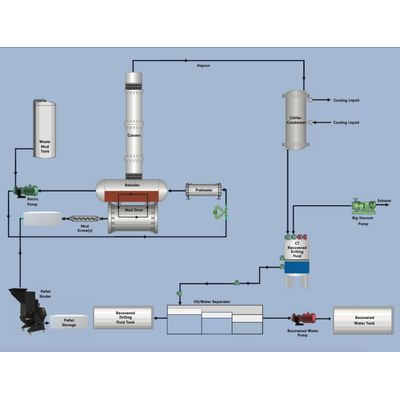
The Vacuum Assisted Pure Oil Recovery technology was conceived and developed as a safe, cost effective and robust solution to the problem of treating waste drilling mud and cuttings without thermally cracking or degrading the valuable synthetic drilling fluid. A secondary goal of the new technology was to minimize the generation of residual waste requiring additional treatment and/or disposal. To achieve this, the technology utilizes a two-stage process that consists of 1) a low vacuum distillation unit (VDU) and 2) a pelletizing process to produce a product that can be utilized as an alternative industrial fuel source. Figure 1 presents a general Process Flow Diagram of the Vacuum Assisted Pure Oil Recovery process.
The first stage of the Vacuum Assisted Pure Oil Recovery process requires heating the material under a low vacuum (i.e. 20–40 mmHg) to evaporate the oil and water fractions, which are subsequently collected, condensed, and separated into hydrocarbon and water products. The process allows for the removal, separation, and recovery of hydrocarbons based on the boiling point of the specific hydrocarbon fractionation. In this manner, the specific hydrocarbon compounds associated with the drilling fluid (typically C10–C24) can be separated and recovered from the general hydrocarbon mixture contained within the waste drilling mud and cuttings.
Inside the vacuum distillation unit, the pressure is reduced to 20–40 mmHg and heat from a thermic fluid heating system is transferred to the waste drilling mud and cuttings through a series of heat exchangers. The use of a low vacuum within the vacuum distillation unit significantly lowers the temperatures required to evaporate the hydrocarbons associated with the drilling fluid. This reduction in boiling point temperatures reduces energy consumption and guarantees that the operational temperature never reaches levels that would result in thermal cracking or degradation of the drilling fluid.
In addition to the high-quality recovered drilling fluid, the technology also generates recovered water and an alternative fuel pellet product. Although different regulatory jurisdictions may have varying discharge criteria, the quality of the recovered water is typically within the environmental criteria for discharge to surface (i.e. < 5 mg/L Total Petroleum Hydrocarbons). Table 1 and Figure 2 show the output and analytical data of the recovered products generated while processing waste mud/cuttings generated from oil exploration activities offshore Nova Scotia, Canada. It resulted in over 200 m3 of drilling fluid being recovered for reuse.
The main technical challenges typically associated with the recovery of the drilling fluids are associated with the following parameters:
- The drilling fluid, comprised of hydrocarbon molecules in the C10–C24 range, are mixed
with reservoir hydrocarbons that typically contain hydrocarbon molecules in the C4
–C60 range. - The drilling fluid will begin to thermally crack at temperatures in the 300–350oC range.
- The temperatures required to remove the high molecular weight reservoir hydrocarbons can
approach 600 C.