


- Home
- Companies
- VDH Water Technology
- Products
- DULCO - Model Lyse - Membrane Cell ...
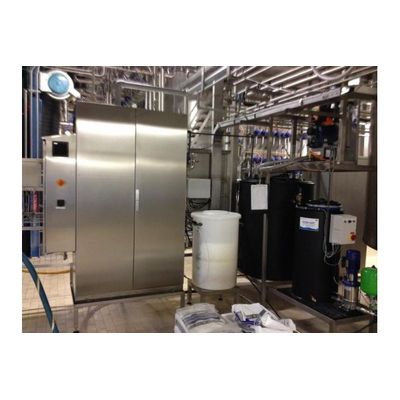
DULCO - Model Lyse -Membrane Cell Electrolysis System
The DULCO Lyse is a membrane cell electrolysis system in which the electrochemical reaction takes place in two electrode chambers (anode and cathode) which are separated by a cation selective membrane. The formation of active chlorine and sodium hydroxide is physically separated. In the DULCO Lyse a very low concentrated mixture (400 ppm) of the freshly produced active chlorine is created. The pH value of the mixture is adjusted between 6 and 7 using the sodium hydroxide. The end product is a highly pure hypochlorous acid which can be stored in small amounts to keep it fresh. The DULCO Lyse systems therefore only need to be designed for average demand, as peaks of capacity can be compensated for from the ECA (day)storage tank.
The DULCO Lyse systems have to be designed for maximum chlorine demands, as peaks of capacity need to be covered by the capacity as such. The advantage of DULCO Lyse membrane cell electrolyser systems lies in their excellent efficiency (85% yield) and no entrainment of chloride or chlorate, normally coming from the anode residue. All this resulting in a low salt- and energy consumption and fixed chlorine concentration of 400 ppm. The extremely low chloride and chlorate levels into the water to be treated are a result of the DULCO Lyse membrane cell technology.
In the DULCO Lyse the freshly produced ECA solution is a mixtures of both pure product (active chlorine and sodium hydroxide) which is commonly accepted in breweries and food and beverage companies.
- Membrane cell technology
- Capacity range: 100 – 300 g/hour
- Production of Hypochlorous acid (HOCl): 400 ppm FAC, pH 6,5
- Salt conversion: approx. 85%
- Salt consumption: 2,0 kg salt/kg FAC
- Electricity consumption: 4,3 kWh/kg FAC
- Electrical connection: 1 x 230 Vac ± 10%, N, PE, 50 Hz