


- Home
- Companies
- Environmental Compliance Equipment ...
- Products
- ECE - Model COP - Oil Water Separator
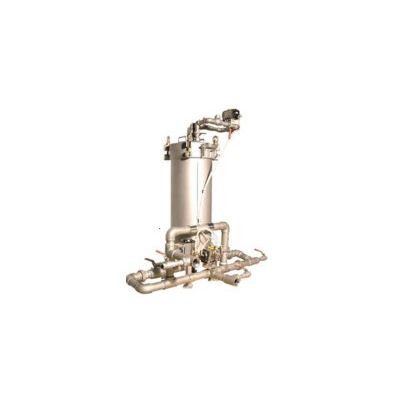
ECE - Model COP -Oil Water Separator
COP is an acronym for Coalescing Oil & Polishing. The COP-System separates and recovers emulsified and free-floating oils (non-dissolved hydrocarbons) from water solutions using a combination of filtration, coalescence, and gravity. It separates oil emulsions as fine as 0.5 micron.
- Produced Water/ Oil and Gas Exploration
- Groundwater Remediation
- Industrial Wastewater
- Bilge Water Discharge
- Tanker and Barge Cleaning
- Food Grade Hydrocarbons
- Oil Spill Response
Extremely low operational expenses and a small footprint make this new system an ideal candidate to replace Dissolved Air Flotation systems, Induced Gas Flotation systems, Centrifuges, Hydro-cyclones, and a wide range of media filters and coalescers.
ROD Media is the COP-Systems` quintessential component. It is a polyurethane based media developed by Separatech Canada Inc. for use in oily water separation processes. ROD Media is a chemically inert, odorless, and a non-toxic organic substance. Its unique physical characteristics allow it to process (coalesce) smaller oil emulsion sizes than any other known coalescing media. ROD Media comes in varying grades which are carefully chosen according to your particular oil content and flow rate.
ROD Media is very oleophilic and hydrophobic. As stable oil emulsions traverse through the ROD Media layers they momentarily attach themselves to the porous media`s cell structure walls and begin to agglomerate with other incoming emulsions. Once the oil emulsions have grown to a certain size, they lose their bind with the ROD Media and are released in the direction of flow.
Stable oil emulsions in water are pumped through (applied pressure) one or more cartridges filled with ROD Media. As oily water passes through the ROD Media, oil emulsions as fine as 0.5 micron are absorbed, coalesced, and released as larger oil globules. Once coalesced, the globules are over 150 micron in size and therefore float quickly to the water surface where they pool together and are easily recovered.
Oil emulsions larger than 20-30 microns which enter the COP-System are removed after having passed through the initial grade of ROD Media at use within the Coalescing Vessel; they never enter the Polishing Vessel. Smaller oil droplets (0.5-20) traversing through the Coalescing Vessel media react similarly to the larger ones (they coalesce and agglomerate), however, their new increased size is often still not enough to enable them to escape through the Coalescing Vessels oil recovery lines. Their slow rising velocity and the short residence time allotted within the vessel do not enable them to reach the Coalescing Vessels surface. Instead, the smaller, remaining oil emulsions are pulled through the system into the Polishing Vessel where they are subjected to one more pass through an ROD Media layer before they can be removed and the COP-System can discharge a clean effluent.
The COP System is available in a multitude of flow rates from single cartridge units to multiple cartridge, thousands of gallons per day process systems. The systems can be configured for any safety configuration such as explosion proof or NEMA4X. The systems can be constructed in carbon steel or stainless steel and be coated with a ceramic clear coat to enhance chemical resistance. Systems can be configured to run manually or fully automatic with PLC operations and HMI (Human Machine Interface) with reporting and access via ethernet.