


- Home
- Companies
- EcoChem Analytics
- Products
- EcoChem - Model PAS 2000 - ...
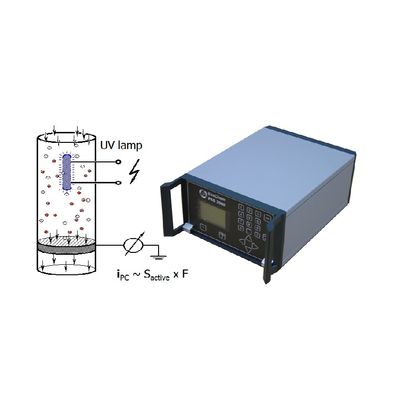
EcoChem - Model PAS 2000 -Photoelectric Aerosol Sensor (Desktop)
Since 1991, EcoChem has pioneered the use of the Photoelectric Aerosol Sensor (PAS) for real-time measurement of Carbon aerosols. Previous versions of the PAS monitor (PAS 1000i, 1000e and 1002i ) are widely used by regulatory, research and industrial organizations.
Incorporating customer feedback and state-of-the-art advances in measurement techniques, the PAS 2000 features the following technological advances:
Use of an UV Excimer lamp. This lamp has a higher efficiency than any traditional UV lamp. The Excimer lamp can be rapidly switched on and off without a time delay. The offset produced by pre-charged particles can be eliminated by operating the lamp in a chopped mode.
- The Excimer lamp produces monochromatic radiation with a half bandwidth of 2%
- Higher sensitivity instrument with a larger measurement range
- Total microprocessor control with internal data acquisition and storage
- Lighter and more compact design
Applications
- Outdoor ambient air quality and monitoring in special settings like parking structures, traffic intersections and motorway tunnels
- Indoor air quality in homes, offices and monitoring indoor sources like kerosene heaters, wood stoves and environmental tobacco smoke
- Workplace monitoring in industrial environments where PAH are produced
- Monitoring carbon aerosols during special situations like Forest Fires, Scrap Vehicle Tire Fires and Agricultural Burns
- Emissions from Combustors, Refinery Heaters, Industrial Boilers and Furnaces
- Emissions from Municipal, Hazardous and Medical Waste Incinerators
- Exhausts from Diesel and Gasoline Engines
- Emissions from Industrial Processes like Coke Ovens, Petroleum Catalytic Cracking, Iron and Steel Foundries, Aluminum and Carbon Black Manufacture
Features
- Uses patented Excimer Lamp technology to detect particle-bound PAH continuously in real-time
- Responds to ultrafine respirable particles which act as carriers of PAH into the body
- Signal has be correlated to particle-bound PAH, Elemental Carbon (EC) and other soot measurement techniques. These carbon aerosols pose the maximum health risk
- Sensitive in the nanogm/m3 to microgm/m3 range
- Simple, reliable, field-rugged and proven technology
- Automated operation requiring minimum human intervention. Built-in data acquisition for 2500 data points
- Proven source monitoring with special dilution sample system
Measuring Principle
The PAS 2000 works on the following principles:
- Using an Excimer lamp the aerosol flow is exposed to UV radiation. The Excimer lamp offers a high intensity, narrowband source of UV radiation. The wavelength of the light is chosen such that only the carbon aerosols are ionized, while gas molecules and non-carbon aerosols remain neutral.
- The carbon aerosol particles emit electrons, which are subsequently removed when an electric field is applied.
- The remaining positively charged particles are collected on a filter inside an electrometer, where the charge is measured. The resulting electric current establishes a signal, which is proportional to the concentration of Elemental Carbon and/ or PAH.
Also by operating the Excimer lamp in a chopped mode, the PAS 2000 can eliminate the background signal, which is associated with freshly generated aerosols. The chopped mode also enables a dynamic zero to be generated automatically by the instrument.
Calibration
Source-specific calibration curves are available or can be generated where the monitor output is compared to an analytically determined EC and PAH concentration. A site-specific calibration curve can provide greater accuracy for the particle size, charge and compound-specific to the source. In addition to the site-specific curves, an approximate universal calibration curve can be used for screening and real-time trending applications.
Chassis and Mounting
Housing Options The ambient air PAS 2000 can have the following housing options:
- Standard desktop unit
- Rack-mount unit
Technical Specification
- Display: LCD Panel with 128 by 64 pixel resolution
- Power: 115 volts AC / 60 Hz & 220 volts AC / 50 Hz, Max. power consumption 35VA
- Range: 0 to 100 picoamp (user selectable)
- Sensitivity: Calibration is site-specific (ng/m3 to microgm/m3)
- Lower Threshold
- Response time: < 10 seconds (adjustable)
- Analog Output: (0 to 10 volt) and ( 0 to 20 mA or 4 to 20mA )
- Digital Output: RS - 232
- Sample gas: Built-in pump with flowrate controlled at 2 L/min
- Operating temp: 40 to 104 ºF (5 to 40ºC)
- Dimensions: Standard Desktop Unit ( Height x Width x Depth ) 4.5in x 9.3in x 12.5in ( 133mm x 236mm x 317mm )
- Weight: 20 lb. ( 9 kg )
- Data Storage: 2500 Data Points (each data point consisting of : Date, Time, Value )
- Software: User-friendly PC-compatible graphical software collects data from PAS 2000. The software displays real-time strip charts and calculates averages. Data is stored in a variety or formats. Flat ASCII file output can also be generated for further analysis in standard spreadsheet programs (e.g. Microsoft Excel).
- Data Acquisition Software: User-friendly PC-Compatible graphical software collects data from PAS 2000. The software displays real-time strip charts and calculates averages. Data is stored in a variety of formats. Flat ASCII file output can also be generated for further analysis in standard spreadsheet programs (e.g. Microsoft Excel).