


- Home
- Companies
- Goudsmit Magnetics Group
- Products
- EddyXpert - Model 1500 mm - Eddy ...
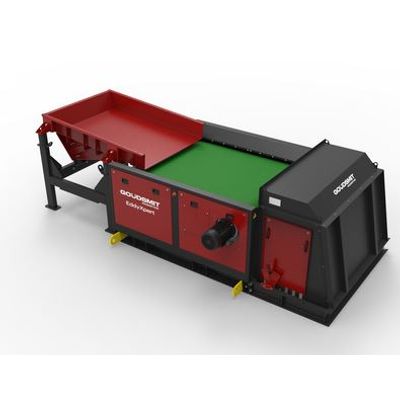
EddyXpert - Model 1500 mm -Eddy Current Separators
The Eddy current separator type EddyXpert is the all-rounder of the ECS machine line and is suitable for a large number of product streams: from coarse to medium-fine fractions. Many possible combinations for desired application.
- Separating NF particles 5-200+ mm
- 12 or 22HI -pole eddy current magnet roller
- Combined ferrous and non ferrous separation possible
- For belt width 600-2000 mm
- Eccentric adjustable magnetic field
They purify large bulk streams and/or separate non-ferrous metals for reuse. Eddy current separators have many uses. They can handle high capacities, because the conveyor belt separates and carries away non-ferrous metals continuously and fully automatically.
An important factor for good separation is an even flow of material, supplied by a vibratory feeder or conveyor belt for example. This results in a uniform distribution across the belt, so that the material arrives as a mono-layer. This means that the supplied layer thickness is about as thick as the largest piece, and thus that there are no pieces lying one on top of the other. This is especially important with smaller fraction sizes. Goudsmit separators are robustly built so they can remain operational day and night in even the most demanding applications, such as incinerator slag reprocessing.
Application of the EddyXpert include:
- recovery of coarse to fine non-ferrous metals from slag from waste incineration plants
- recovery of precious metals from scrap or electronics waste
- recovery of casting residues in the metal casting industry
- elimination of metals out of shredded wood chips
- elimination of aluminium for the glass recycling industry
- elimination of impurities from recycled plastic streams for protection of injection moulding machines
Material
Some non-ferrous metals are more easily separated than others. This has to do with the physical properties. This table lists non-ferrous metals categorized on the basis of three factors. The first column shows the electrical conductivity of the material: a measure of how easily a material conducts electricity. The second column indicates the density of the material. This is important for the effect of gravity on the ejected piece of metal. After all, the eddy current forces generated by the eddy current magnet roller must overcome these forces. The last column shows the ratio between these two factors. The greater the electrical conductivity and the lower the density, the better a material can be separated with the eddy current technique.
Size and shape
The fraction size (i.e. the size of the particles in the flow of material) is also a very important factor for achieving good separation. Eddy currents induce repulsive forces in a piece of metal that cause it to be ejected with a certain trajectory. As a result, the non-ferrous metals have a different ejection trajectory than the other residue and inert materials in the product stream. This ultimately results in a ‘range of trajectories’ for inert and non-ferrous material. The larger the volume, the more widely ‘separated’the ejection trajectories of a chunk of inert material and a non-ferrous metal object of the same volume. This is why it is easier to separate aluminium cans than small copper wires.
Size plays a role, as does the shape. For example, a ball has less air resistance than a tangle of copper wire or a bent piece of sheet metal.
Conveyor belt
The EddyXpert separators can be equipped with 3 types of conveyor belts:
1. PU conveyor belt: These tires have on average a 2x longer lifespan than the less durable and cheaper PVC conveyor belts. We prefer these tires because they are durable and can be produced thin. A thin conveyor belt has the advantage that the magnetic force is higher, which in turn results in a better separation of metals.
2. Rubber conveyor belt: These tires are a lot thicker, which reduces the magnetic force on the belt surface. Rubber is resilient and can absorb the impact of sharp or large parts.
3. PVC conveyor belt: These tires are the cheapest and the least durable.
Slide plates
Non Ferrous metals will be separated better when they lay still at the separation point of the eddy current magnet roller. Therefore the conveyor belt is supported by Stainless steel sliding plates, which ensure flat and stable transportation of the material. Competitors use conveyor belt support rollers which make materials bounce which has a negative effect on separation. They also add extra maintenance to the machine, because the bearings of the support rollers need to be changed.
Integrated drum motor
An integrated drum motor provides the drive for the conveyor belt. This provides a compact design, because there is no motor protruding from the rear of the machine. This drum motor has an IP66 protection rating, so it is well protected against dust and moisture. This means that the motor is virtually maintenance-free, which contributes to making this a robust and user-friendly machine, a fact that will surely be appreciated by your operators.
Eddy current separators have a conveyor belt system with a high-speed magnetic rotor at the end. The rotation speed of the magnets generates an induction field, creating a rapidly changing magnetic field. See animation. The separation is based on the principle that every electrically conductive particle located in an alternating magnetic field is temporarily magnetized.
Simply put: for a brief moment all metals that pass the eddy current magnet roller become magnetized themselves, causing them to be ejected. This enables us to separate a huge number of non-ferrous metals and their alloys, including aluminium, copper and brass.