


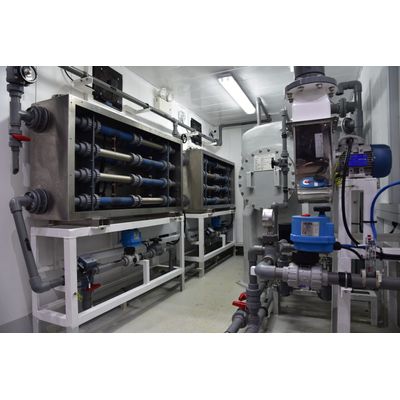
The process of electrochlorination is simple. It is the electrolysis of saltwater to produce a chlorinated solution. The first step is removing any solids from the saltwater. Next, the saltwater streams through an electrolyzer cell’s channel of decreasing thickness. One side of the channel is a cathode, the other is an anode. A low voltage DC current is applied, electrolysis happens producing sodium hypochlorite and hydrogen gas (H2). The solution travels to a tank that separates the hydrogen gas based on its low density. [1] Only water and ordinary salt, (sodium chloride (NaCl)) are used.
Companies may use seawater for this process due to its low cost. The water used is usually brackish water or brine (i.e. a solution with >0.5% salinity). In these cases, additional contaminant chemicals may be present in the water feed. The low voltage DC current still performs electrochlorination. The excess chemicals are left untouched and can be easily discarded.[2]
The product of the process, sodium hypochlorite, provides 0.7% to 1% chlorine. Anything below the concentration of 1% chlorine is considered a non-hazardous chemical[according to whom?] although still a very effective disinfectant. The sodium hypochlorite produced is in the range of pH 6-7.5, relatively neutral in regards to acidity or baseness. At that pH range, the sodium hypochlorite is relatively stable.[3]