


- Home
- Companies
- Electrolab Biotech Limited
- Products
- Electrolab Biotech FerMac - Model 200 - ...
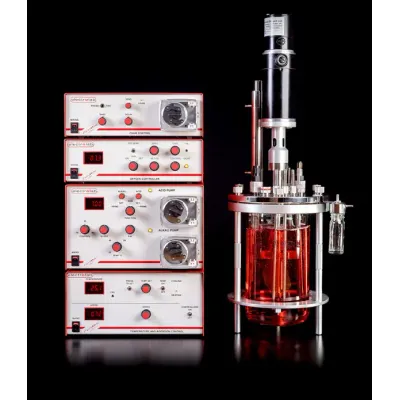
Electrolab Biotech FerMac - Model 200 -Modular Benchtop Fermenter System for Microbial Applications
The FerMac 200 series is a modular bench-top fermenter system developed for microbial applications. Its design enables ease of maintenance and cost-effective operation. The system comprises independent modules that can stack to form a cohesive control unit, streamlining the configuration. Modules available include temperature and agitation control (FerMac 231), temperature control (FerMac 240), oxygen control (FerMac 251), pH control (FerMac 260), and foam/level control (FerMac 280). Each module features industry-standard sensors and integrated control mechanisms. The FerMac 231, for example, combines a direct drive DC motor with a Pt100 temperature sensor and a Wipe-clean silicone heater blanket, ensuring reliable and safe temperature and agitation control. The FerMac 240 focuses primarily on temperature control, while the FerMac 251 and 260 are designed for oxygen and pH control respectively, utilizing industry-standard sensors for precise measurement and control. Lastly, the FerMac 280 manages foam and level control with an adjustable conductivity sensor and integrated peristaltic pumps.- Low cost, low maintenance truly modular system
- Robust, easy-to-use control modules
- Fully autoclavable vessels with baffles and cooling coil
- Modules stackable to create neat, combined unit
- Interlinking power-cables
- Modules available individually for specific control requirements
- Data-logging via Electrolab e-Logger, or other datalogging systems
Modular design and combined control system
Each module, although totally independent, can stack together to create an extremely neat, combined control system. They are also available individually, enabling specific control functionality to be used with your existing bioreactors, spinner flasks etc.
Fermac 200 modules
Each module, although totally independent, can stack together to create an extremely neat, combined control system. They are also available individually, enabling specific control functionality to be used with your existing bioreactors, spinner flasks etc.
Our modular control system
The FerMac 200 series offers a real alternative to our competitors with a truly modular system approach. Each module, although totally independent, can stack together to create an extremely neat, combined unit with inter-linking power cables.
The controllers are easy to understand and simple to use - ideal for projects where equipment familiarisation time may be limited - and because the modules are totally independent, they can also easily be used to upgrade older equipment.
The FerMac 200 has one of the lowest purchase and maintenance costs in the industry, allowing you to get the most from a limited budget.
Our modular control system
The FerMac 200 series offers a real alternative to our competitors with a truly modular system approach. Each module, although totally independent, can stack together to create an extremely neat, combined unit with inter-linking power cables.
The controllers are easy to understand and simple to use - ideal for projects where equipment familiarisation time may be limited - and because the modules are totally independent, they can also easily be used to upgrade older equipment.
The FerMac 200 has one of the lowest purchase and maintenance costs in the industry, allowing you to get the most from a limited budget.
Industry standard sensor
Temperature control is achieved using an industry standard Pt100 sensor for stable measurement with the temperature displayed on an LED display. A single push switch changes the display to read the set point parameters.
On demand cooling
The bioreactor is heated by a wrap-around silicone heater blanket which operates at low voltage, making it safe to use in the wet laboratory environment. It can easily be wiped clean if it becomes soiled, and we are able to produce special heater jackets (or mats) on request for your specific purpose.
Cooling is on demand, operated by a valve mounted on a separate service plate and enables cooling water to circulate through the heat exchanger. Water and electrics are kept strictly segregated.