


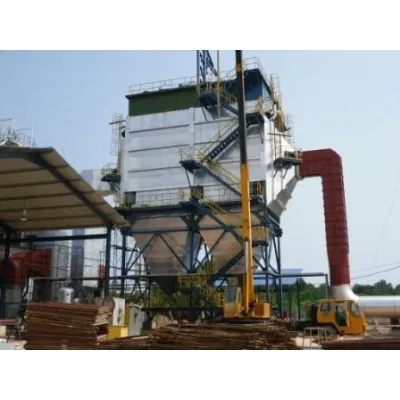
Electrostatic Precipitator for Industrial Emission Control
Electrostatic precipitators, designed by Intensiv Filter Himenviro, are crucial industrial emission-control devices used to remove fine particles from gases. Utilizing an electric charge, these precipitators target and eliminate tiny solid impurities or liquid droplets from exhaust gases found in smokestacks and flues. The technology involves charged particles being attracted to plates, ensuring an efficient collection rate of up to 99.9%. These devices have diverse applications across industries, especially in power plants, where multiple units may be deployed. Differentiated into dry and wet types, ESPs handle a range of particulate materials, from wood ash to sulfuric acid mist, adapting to various gas volumes and temperatures. Notably, dry ESPs operate at temperatures above the dew point, making them suitable for dry dust collection, whereas wet ESPs cater to exhaust systems with oily and sticky particulates. While initial costs may be high, ESPs offer low maintenance and operational costs, with benefits in cleaning efficiencies and pollutant removal. Their design incorporates features like mechanical rappers for dust removal, ionization for particle charging, and multiple configurations to meet specific industrial needs, ensuring compliance with environmental standards and reducing health risks associated with industrial emissions.
An electrostatic Precipitator or electrostatic air cleaner is a filterless device that is used to remove impurities or fine particles from a flowing gas. It uses an electric charge to remove tiny solid impurities or liquid droplets from the air or gases in smokestacks and other flues. Due to the electrical forces, the particles move from the air stream to the collection plates. Particles passing through the precipitator are given a negative electrical charge by being forced to pass through a region, called a corona, where the gas ions flow. When the particle becomes negatively charged, it is then forced towards the positively charged plate. With the help of a knocking action, particles are removed from the plate.
An electrostatic precipitator is a large, industrial emission-control unit. It is designed to trap and remove dust particles from the exhaust gas stream of an industrial process. Precipitators are used in these industries:
- Power/Electric
- Cement
- Chemicals
- Metals
- Paper
In many industrial plants, particulate matter created in the industrial process is carried as dust in the hot exhaust gases. These dust-laden gases pass through an electrostatic precipitator that collects most of the dust. Cleaned gas then passes out of the precipitator and through a stack to the atmosphere. Precipitators typically collect 99.9% or more of the dust from the gas stream.
Depending upon dust characteristics and the gas volume to be treated, there are many different sizes, types and designs of electrostatic precipitators. Very large power plants may actually have multiple precipitators for each unit.
Electrostatic precipitators were originally designed for recovering valuable industrial process materials. But now, these precipitators are used for air pollution control at industrial facilities and power generating stations. They are primarily used for removing harmful particulate matter from waste gases. These particulates have several adverse effects if released into the atmosphere. They can reduce visibility, contribute to climate change, and lead to serious health problems in humans, including lung damage and bronchitis. Though the initial cost of ESPs is a little higher than local exhaust ventilation systems, owing to the multiple advantages, it becomes worth considering. ESPs require very little maintenance after installation because there are no moving parts. The installation time and cost of operation are also less as compared to a local exhaust ventilation system. One more advantage is that the product is easily recovered and recycled back into the process.
Electrostatic Precipitators use electric forces to separate suspended particles from gases. This is carried out in two basic steps:
- A corona-charging field provides the particles with an electrical charge.
- A high-voltage collecting field attracts the charged particles to the collecting electrodes.
The treated air is then released into the atmosphere through the stack. When sufficient particles get deposited on the collection devices, mechanical rappers are used to shake the particles off the collectors. These tiny particles, which can be dry or wet, fall into the hopper and are transported away for disposal through a conveyor system.
The most common commercial electrostatic precipitators are designed with a row of thin vertical wires and a stack of large flat vertical metal plates. The spacing between these plates varies from less than 1.3 cm (0.5 inches) to about 17.8 cm (7 inches). The gas stream flows horizontally between the wires and through the stack of plates. To remove impurities from the gas stream, a negative charge of several thousand volts is transmitted between the wires and plates.
The plates of the Plate Precipitators can be sometimes difficult to clean and can also produce ozone and nitrogen oxides. Some precipitation filters are provided with special soak-off cleaners that allow the entire plate array to be removed and soaked for several hours, which loosens the particulates. A high voltage is applied to the discharge electrode that generates a corona discharge which produces minus ions. Electrically charged dust is accumulated on the collecting electrode by an electrical field. The accumulated dust is removed by rapping hammer (dry ESP), scraping brush (dry ESP), or flushing water (wet ESP).
Dry electrostatic precipitator ( ESP )
These types of precipitators are employed on hot process exhausts (250 – 850 deg. F) that operate above the dew point of the gas stream. They majorly collect dust particles such as wood ash, incinerator ash, or coal ash from boiler or incinerator applications. Some other dry electrostatic precipitator applications include carbon anode ovens, cement kilns, and petroleum cat crackers. Dry ESPs are more widely used due to the fact that they collect and transport dust in dry conditions. This eliminates the use of water and the concerns of pollution, corrosion, and dewatering efforts associated with scrubbers. If the dust particles can be collected and managed in a dry condition it is always advisable to install a Dry ESP.
Wet electrostatic precipitator ( WESP )
Dry ESPs can achieve a 99+% collection efficiency for coarse and fine particulate removal but lacks efficiency in removing moist or sticky particulate that would stick to the collection surface Wet Electrostatic Precipitators in exhaust systems can be used for materials that contain wet, sticky, tar-like, tacky or oily particulates. Wet ESPs employ an old technology designed in the 1920s to collect sulfuric acid mist using lead collection tubes. In today’s time, WESPs are employed on gas streams that include oily and sticky particulates or gas streams that must be cooled to saturation in order to condense aerosols that were formerly in the gas phase.
Dust Collection Performance and Dust Characteristics
Our accumulated know-how in evaluating characteristic assessments on various dust properties and flue gas conditions, together with extensive field experience, are reflected in the ESP design.
ESP Performance Improvements to counter High-Resistivity Dust
The most important consideration in baghouse filter electrostatic precipitators and scrubbers is to maintain and increase the dust collecting performance of high-resistivity dust. Several measures to compete high-resistivity dust have been established.
Our technologies are shown in the following table. We offer suitable technologies for plant applications and operations and can realize both compact design and high efficiency.