


- Home
- Companies
- hamos GmbH
- Products
- hamos - Model EKS - Electrostatic ...
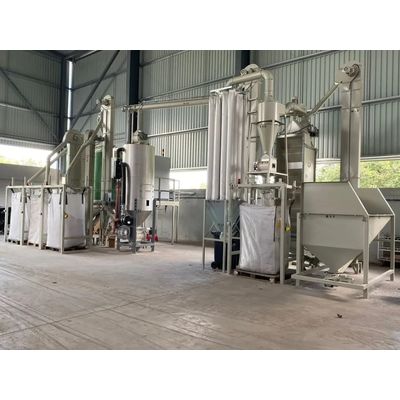
hamos - Model EKS -Electrostatic Separator for Clean Plastics
Single-variety plastics with electrostatic Separators hamos EKS With hamos EKS electrostatic separators, you can separate plastic mixtures into their components in a dry process. hamos EKS separators can also be used to separate unwanted plastic impurities. By utilising the tribo-electric behaviour of the individual plastics, the hamos EKS separates your mixed materials into unmixed fractions with little effort. This allows you to recover valuable raw materials for new, high-quality products from mixed plastic waste.
In order to obtain an optimum separation result with the hamos EKS, the plastic mixtures to be separated must have the following characteristics:
- Mixture of non-conductive materials
- Completely disintegrated material (no composite materials)
- Different tribo-electric charging behaviour
- Dry material (ideal surface moisture < 0.8 %)
- Dust-free material
- Particle size between 2 and 12 mm
- Ideally two-component mixtures
You are not certain whether your material is suitable for electrostatic separation? Speak with our experts. After you have checked with us, we will be pleased if you send us a material sample of approx. 20 kg, with which we can investigate the separation capability of your material in our technical department.
We will show you which purity and throughput can be achieved with your material. You will receive our test report based on the separation test results. We will gladly offer you an optimum piece of equipment or system for your application.
You will be astonished by the value creation that you willl be able to achieve with your material when it has been separated into clean fractions
hamos EKS electrostatic plastic separators use the differences in the tribo-electrical behaviour of the individual plastics for separation.
The plastic mixture is fed into a so-called tribo-electric charging unit via a vibrating conveyor. Different plastics are selectively charged in a material-specific manner and take on a positive or negative charge. This effect is caused by the transfer of electrons from one particle to another.
After charging, the plastic mixture enters a high-voltage field where the components are separated electrostatically into pure fractions due to their different charges. Positive particles are attracted to a negative electrode, while the negative particles are repelled and vice versa.
With minor modifications to the charging unit and a readjustment of the separating plates, it is possible to separate different plastics one after the other without great effort. For example, PET-PVC and then PE-PP can be separated with the same machine.
- Dry separation process
- High product purity
- Independent of specific weight and colour
- Flexibility: One device for many plastic mixtures
- Low good material losses
- Proven technology
- Rapid amortisation
- High throughputs
- Low energy consumption
- Low personnel deployment
If you recycle, for example
- Plastic production waste
- Plastics from cable waste
- PVC window profiles
- PET beverage bottles
- Engineering thermoplastics
- Plastics from electronic waste
- DSD packaging materials
- Bottle caps (closures)
- Plastics from car production
- Refrigerators
- Other mixed plastics
the hamos EKS is the ideal equipment for plastics separation.