


- Home
- Companies
- Emiflex S.p.A.
- Products
- Emiflex - Bellows Joint
Emiflex - Bellows Joint
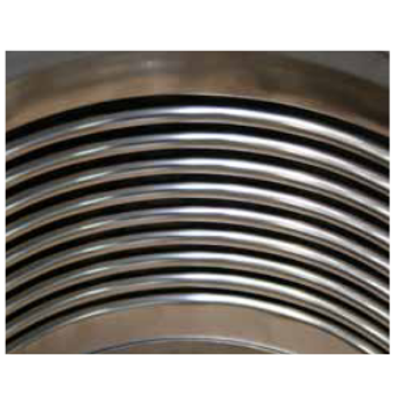
Bellows are the key component of an Emiflex joint. It is defined as a highly flexible metal element that resists pressure. Bellows are obtained by a mechanical or hydraulic cold forming process. The austhenitic stainless steel is longitudinally welded using theT.I.G. welding method and the bellows are shaped into a serious of parallel corrugations. To achieve maximum flexibility coupled with the required resistance to pressure, bellows are formed with multiple walls using a number of concentric cylinders of stainless steel, each longitudinally welded. In this way, all the walls contribute to providing pressure resistance, while flexibility is ensured by the reduced thickness of each wall.
MATERIALS
The standard material used to manufacture Emiflex bellows is stainless steel ASTM A240TP321 that guarantees formidable resistance to temperature and corrosion, covering a wide range of applications. On request, we can manufacture bellows with other types of austhenitic steel, i.e. AISI 316Land AISI 316Ti, or with materials such as: MONEL,INCONEL, TITANIUM, etc.
PERFORMANCE TEST
Emiflex has standardized the most frequently used bellows, classifying them based on movement capacity (stroke) for every DN (Nominal Diameter) and PN (Nominal Pressure). The bellows are sized in accordance with the calculation model EJ.M.A. (Expansion Joints Manufacturers Association, USA). EJ.M.A. is the most widespread and acknowledged method. It is the result of many years of research, tests and experimentation in the aerospace industry.
To cross-check the data obtained with this method, we conduct numerous test in our laboratory including:
- HYDROSTATIC TEST: to check bellow stability
- INDUCED STRESS TEST: to calculate the bellows` lifespan
Resistance to internal pressure goes with the need to have highly flexible bellows. The bellows`elasticity can however provoke instability either
local or wave-related. (Figure 5) Instability does not jeopardize the bellows` resistance, but may well shorten the working life of the joint.
This phenomenon can easily be avoided by carefully properly sizing the bellows.