

Environmental Control & Custom HVAC Systems
At Air Innovations, we specialize in the design and development of self-contained and remote packaged cooling systems for the precise control of temperature, humidity, and filtration. Our core strength is our ability to understand technical environmental requirements, constraints, and goals and then to transform those elements into a custom packaged process environmental control system for our customers.
Environmental control systems-also referred to as environmental control units (ECUs)-are devices used to regulate environmental conditions within a space. They play a critical role in a variety of industrial applications. By ensuring operating temperature, humidity, and other parameters are at appropriate levels, ECUs help industry professionals achieve optimal process effectiveness and efficiency.
We customize our environmental control and HVAC solutions to the needs of the customer. The table below outlines our core capabilities.
Temperature Control:
Control environments from 0°F to 100°F (-18°C and 38°C) with tolerances as precise as ±0.02°C
Humidity and Dew Point Control:
Control tolerances to ±0.5% RH; Desiccant to 95% RH
Filtration:
HEPA, ULPA, molecular
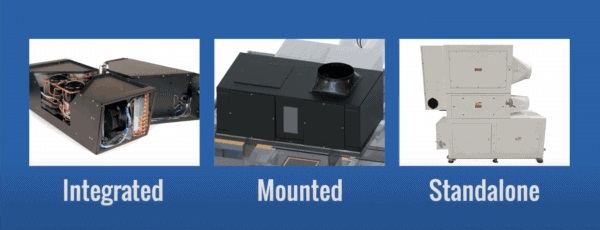
Our ECUs are available in three configurations:
- Integrated. These units are designed to accommodate an existing equipment structure, resulting in a smaller footprint, greater system efficiency, and lower installation costs.
- Mounted. These units are attached to an existing system and can be designed to reduce a system’s overall weight and footprint.
- Standalone. These units are placed around equipment rather than in or on them, allowing for greater flexibility regarding system location, installation, configuration, and performance capabilities.
Some of the features regularly incorporated into our environmental control units include the following:
- Typical (DX) or specialty refrigerants
- Water-cooled environmental control units
- Thermoelectric environmental control technology
- Explosion Proof Systems
- Ruggedized / Military-grade HVAC Systems
- From large to small/constrained environmental control systems
- Stationary or mobile environments
- Humidification and dehumidification, ultrasonic or steam humidification
Our experts provide custom HVAC system design, prototype building, testing, and manufacturing services. By offering complete custom solutions, we ensure the system we deliver fully complies with the requirements and restrictions of the application.
Compared to standard HVAC solutions, custom HVAC solutions offer a number of advantages. By investing in a custom system, industry professionals can tailor the unit to accommodate their exact needs, including with regard to operating environment, size constraints, regulatory and industry standards, and efficiency requirements.
At Air Innovations, we provide ECUs to fit your unique application. Our team will work collaboratively with you to determine your specifications, overall budget, and any additional requirements or desired customizations. We will then create a cost-effective design tailored to your needs. Click through the four steps below to learn more about the process of creating a custom ECU with Air Innovations.
- Cost
- Space and size constraints
- Indoor/outdoor
- Pressurization
- Configuration: Integration into an existing system, standalone, or mounting
- Volumetric airflow: How much air they need to pass through the system in a period of time, typically in cubic feet per minute (CFM)
- Once-through air or recirculation of air: Air can be much cleaner if it’s recirculated through a captive space
- Redundancy: How critical is it for the system never to go down?
- Exposure: To chemicals, weather, transportation, military settings, explosion-proofing, and/or seismicity
- Variation of the heat load: A system might need to go down to -2° C (29°F) in January, but hits 106°F or higher in July. The system had to be designed to deal with those extremes.
- Environmental friendliness/certifications: The global warming/environmental impact potential of the refrigerant used within the system
- Electrical characteristics: 50Hz/60Hz or other; systems on a ship or plane may have different characteristics
- Construction materials: Material factors for system construction are usually dependent on the factors above.
- Temperature control: Control environments from 0°F to 100°F (or -18°C to 38°C) with tolerances as precise as ±0.02°C