
Input Voltage: +24VDC (Nominal) +18 to 32 VDC
Battery Operated by Request
Power Consumption: ≤ 4W for the monitoring module
≤ 5V for the EC sensor
Output Signals: Wireless HART
Digital RS-485 Modbus RTU


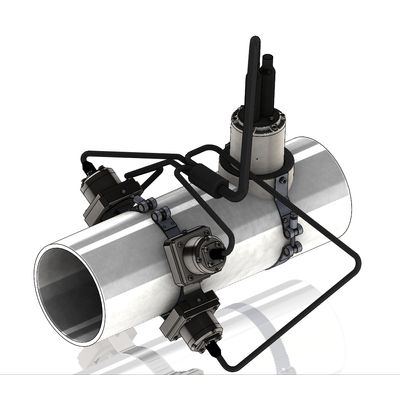
Erosion-corrosion has been rated in the top five most prevalent forms of corrosion damage in the oil and gas industry and defined as accelerated corrosion following the removal of surface films.
Erosion in oil and gas production systems is mainly due to the presence of sand along with liquid and gas. It is associated with production velocities and is the most severe when production velocities are high.
Since erosion is caused by mechanical forces occurring on the metal surface, erosion can be difficult to control. To address this industry problem ESP Safety has developed Echo-EC Erosion-Corrosion Detector.
The Echo-EC monitors the condition of pipes and provide information about its erosion corrosion rate in various applications. ECHO-EC uses a group of acoustic sensors to detect wall thickness by pulse-echo method. The quantity of sensors in a system varies from 4 to 32 pcs. The output signals from Echo-EC acoustic sensors are transmitted directly to a control system for online data monitoring via Modbus RS-485 communication protocol.
Being the next generation of smart instruments Echo uses advanced digital signal processing algorithms to provide reliable, high-resolution data to operator. This allows users to plan preventative measures, optimize use of corrosion inhibitors, calculate the remaining lifetime of pipeline, monitor weld/HAZ on pipe, verify and calibrate inspection pigs and provide information about critical areas between inspection surveys.
The Echo-EC non-intrusive device can be easily tied into any existing system or implemented into new pipeline installation.
ESP Safety’s erosion corrosion detector is recommended to be installed in combination with our sand detector to minimize sand intrusion (the main cause of erosion corrosion), detect early signs of corrosion and extend life of pipelines.
Input Voltage: +24VDC (Nominal) +18 to 32 VDC
Battery Operated by Request
Power Consumption: ≤ 4W for the monitoring module
≤ 5V for the EC sensor
Output Signals: Wireless HART
Digital RS-485 Modbus RTU
Dimensions: Monitoring Module 5.9” x Ø 3.9” (150 mm x Ø100 mm)
ECHO EC sensor 2’’ x 4’’ x 5’’ (50 mm x 95 mm x 125 mm)
Material: Stainless Steel 316L
Weight: Monitoring Module 6 lbs (3 kg)
ECHO EC Sensor 1 lb (0.5 kg)
Method of Operation: Passive acoustic
Flow Regime: Oil, Gas, Water, Multiphase
Units of measurement: Wall loss (mm), corrosion rate (%)
Calibration: factory calibrated, no field calibration required
Resolution: 0.001” (0.025mm)
Pipe Size: > 3 inch OD (76 mm)
Coverage Area: 32 sq.ft (3 sq.m)
Wall Thickness: 3 – 50 mm (0.1 -2 inches)
Pipe Material: Metal Alloys
Pipe Coating: Any, no need to remove coating
Operating Temperature: -20C to +80C ( -76F to 185F)
Pipe Surface Temperature: -100C to +290C ( -148F to 554F)
Storage Temperature: -50C to +50C ( -58F to 122F)
Design Life: 30 years
Welds
Heated Weld Zones
Pipeline bends/elbows
Pipeline-joints
Vessels/Tanks