


- Home
- Companies
- Environmental Technology, Inc. (ETI)
- Products
- ETI - Model RCD Series - Low Cost ...
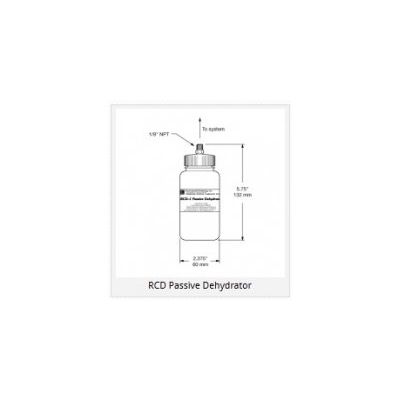
ETI - Model RCD Series -Low Cost Passive & Passive Self-Pumping Dehydrators
The RCD line of passive dehydrators keeps small volume waveguide and coax systems dry. These dehydrators may also be used to supply short term protection for larger systems; during power interruptions, maintenance, storage, or transportation.An RCD passive dehydrator contains a drying agent sealed in a pressure tight container. A 1/8″ NPT pressure fitting is provided for connecting to the system to be protected. Gas diffusion insures that the desiccant is exposed to any water vapor present in the system. Unlike mechanically pressurized systems, an RCD passive dehydrator works best when the waveguide or coax system is tightly sealed.
Containing just one moving part, an RCD self-pumping passive dehydrator uses variations in ambient temperature and barometric pressure to pressurize the waveguide or coax. When the pressure inside the waveguide is less than atmospheric, a sensitive check valve in bottom of the bottle opens. This allows ambient air to enter the waveguide or coax after it has passed through and been dried by the desiccant. When the internal pressure exceeds atmospheric, the check valve closes thus holding the system at a positive pressure.
This feature improves performance in two ways. First, it increases drying efficiency by keeping the system at a positive pressure. Thus dry air generally leaks out rather than moist air leaking in. Second, this feature insures controlled dry air circulation in the waveguide or coax. When compared to a passive dehydrator that relies upon gas diffusion, circulation dramatically improves response to environmental changes.
Depending upon the system volume and tightness along with environmental conditions at the site, the desiccant lasts 12 to 18 months, or longer, before requiring regeneration or replacement. Conditions such as a leaky system and damp climate may reduce desiccant longevity.
- Maximum dehydrated volume : One cubic foot
- Desiccant replacement/regeneration interval : Typically 12 to 18 months, or more
- Rated pressure : Up to 8 psig
- Maximum pressure : 20 psig
- Desiccant RCD–1, 2, 3, 4 : Sorbead Orange alumino-silica gel
- Desiccant RCD–5, 6 : Molecular sieve desiccant with blue indicating gel
- Check valve sensitivity (RCD–2, 4, 6) : Nominally 0.1 psig
- Keep waveguide and coax dry
- Low Cost
- Reliable
- No power required
- Long desiccant life
- Simple Installation
- Desiccant indicates when to regenerate/replace
- Self pressurizing (RCD-2, RCD-4, & RCD-6)