


- Home
- Companies
- Expo Process Analytics
- Products
- Expo Process Analytics - Model Taso™ - ...
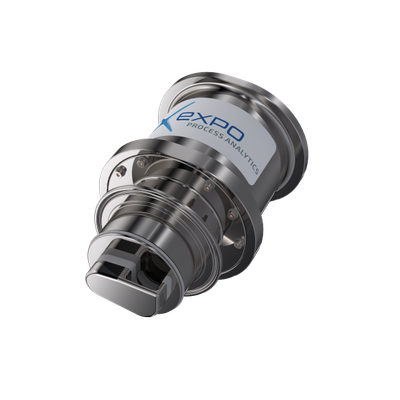
Expo Process Analytics - Model Taso™ -Inline Process-to-PAT Interface System
The Taso™ inline process-to-PAT interface is engineered to optimize solids processing by integrating seamless, real-time particle analysis within manufacturing workflows. This technology addresses the inherent challenges in inline PAT (Process Analytical Technology) measurement, particularly in operations such as spray drying and milling where particle streams are widely dispersed. Taso™ employs a unique 'spoon' mechanism to capture and concentrate samples for enhanced spectroscopic analysis, thereby providing reliable data on critical quality attributes like particle size and moisture content. Such immediate data availability is pivotal for advanced manufacturing techniques, including risk-based process development and real-time release. The interface helps in reducing overall processing errors by ensuring high-fidelity data capture, thereby supporting robust process control in pharmaceutical and food production. Its design also includes mechanical wiping and optional heating elements to mitigate probe fouling, maintaining consistent data integrity.
Unit operations for solids processing involves the ability to effectively process and measure a variety of stream types. For example, granulation often results in a dense and “sticky” particle stream and spray drying results in a disperse and dry particle stream. The ability to measure these solids inline with PAT inform on critical quality attributes of particle size, moisture content, and crystallinity in real time. These PAT data are the foundation for advanced manufacturing approaches such as risk-based process development, advanced process control, digital twins, and real-time release. Based on our years of experience in pharmaceutical solids manufacturing, we have developed novel process-to-PAT interfaces to ensure robust PAT in solids and enable advanced manufacturing approaches.
Taso™
Disperse streams are commonly found in milling and spray drying operations. Spray drying uses hot gas to create a fine powder from a liquid or slurry, and it is an important unit operation in the manufacture of pharmaceutical solids and foods. Milling uses a variety of mechanical operations to achieve the target particle size and morphology. A suboptimal spray drying or milling operation wastes utilities costs, affects a product’s critical quality attributes, and impacts the product’s ability to be processed in downstream operations such as blending. PAT approaches are commonly proposed to provide automated quality control on critical quality attributes of particle size and moisture content.
The disperse amount of these powders that come out of these processes is a challenge for spectroscopic PAT systems because these unit operations require a fast measurement time in a vanishingly amount of sample. Spectroscopic PAT probes such as Near Infrared Spectroscopy (NIR) installed at the outputs of mills and dryers are often unable to capture data of sufficient quality to allow accurate particle size and moisture prediction due to the disperse nature of the granule and powder streams at these points in the process.
We developed the Taso™ process-to-PAT interface to address this challenge. The Taso™ is an inline probe interfaces that uses a “spoon” to collect this dispersed sample stream in front of the probe window until a dense sample bed has been built up to allow a high quality PAT measurement. The “spoon” then flips to return the sample to the process and starts collecting again. Similar to the Rado™, it also performs mechanical wiping to reduce probe fouling (available with an optional heater element).