
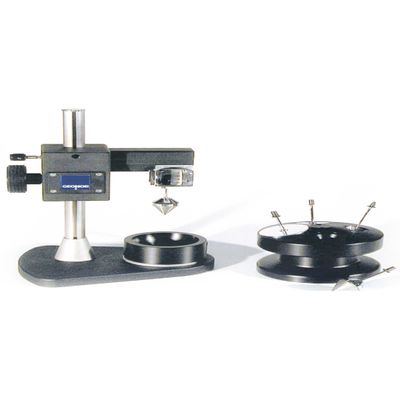
Geonor - Model G-200 -Fall Cone Apparatus
The Fall Cone apparatus, first introduced in 1915, provides a rapid, simple and accurate method for determining empirically the undrained shear strength, the shear strength of remoulded samples and thus the sensitivity of clays. The equipment is also used for determination of liquid limit WL (or fineness number WF). Four cones of different weight and apex angle are provided. The diagram shows the relation of shear strengths in undrained and remoulded samples measured by cone test, vane tests and unconfined compression test (Norwegian Geotechnical Institute Publ. 41, Oslo).
The cone apparatus is used to determine undrained shear strength in cohesive soils (clay).
- Portable and easy to use, even in field trials.
- Supplied with a robust and specially adapted transport case.
- Test capacity: shear strength 0.01 to 200 kPa (0.001 to 20 t/m2).
Easy and accurate determination of:
- undrained shear strength.
- shear strength in stirred samples and thus sensitivity (St).
- floating limit (WL).
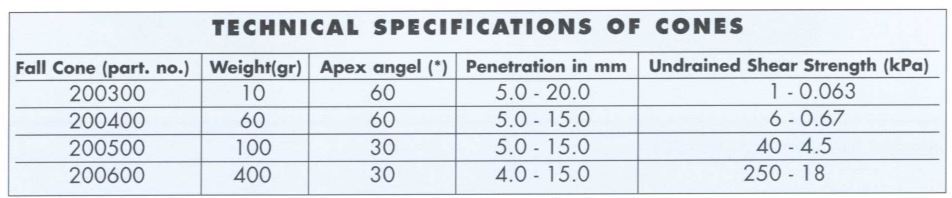
Available with 10, 60, 100 and 400 gr. cones with different top angles. Independent of electric power or battery, and developed in collaboration with the Norwegian Geotechnical Institute.
- Rapid, simple and accurate measurement of:
- Undrained shear strength
- Shear strength of remoulded samples and thereby sensitivity
- Liquid limit WL
- Testing capacity: Shear strengths of 0.01. to 200 kPa (0.001 to 20t/m2)
- Portable and easy to use
- Designed by the Norwegian Geotechnical Institute, NGI
The shear strength of a soil is (s) is proportional to the weight of the cone (Q) and inversely proportional to the square of the penetration (h) of the cone into the sample: s=K·Q/h² (Hansbo, S (1957): A new approach to the determination of the shear strength of clay by the fall cone test. Swedish Geot. Inst. Pub. No. 14, Stockholm). The proportional constant K depends primarily on the angle of the cone and sensitivity of the clay.
The shear strength is measured by placing the sample underneath the cone holder, with the tip of cone touching the sample. After releasing the cone from the magnet holder and measuring the depth of penetration, the shear strength of the undisturbed or of the remolded sample is given in tables accompanying the apparatus.
The standard cone used to determine the liquid limit WL (see diagram) has a weight of 60 gr and an angle of 60° (part no. 200400). The upper limit of plasticity corresponding to the liquid limit is defined as the moisture content at which the cone impression is 10 mm (Karlsson, see referen??).
The undrained shear strength of an undisturbed sample is first measured. Thereafter, the sample is completely remolded and the new shear strength is measured with the same water content. The ratio of the undisturbed to remolded shear strength is defined as the sensitivity (S, in diagram)