- Home
- Companies
- Berkeley Nucleonics Corporation (BNC)
- Products
- Berkeley - Model 765 - Fast Rise Time ...
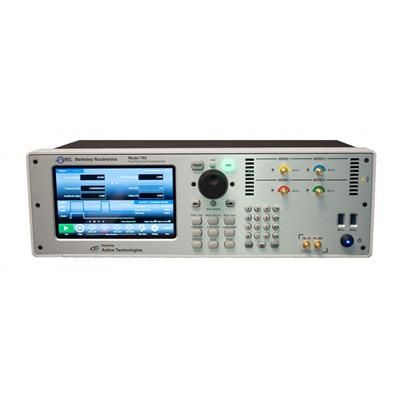
Berkeley - Model 765 -Fast Rise Time Pulse Generator
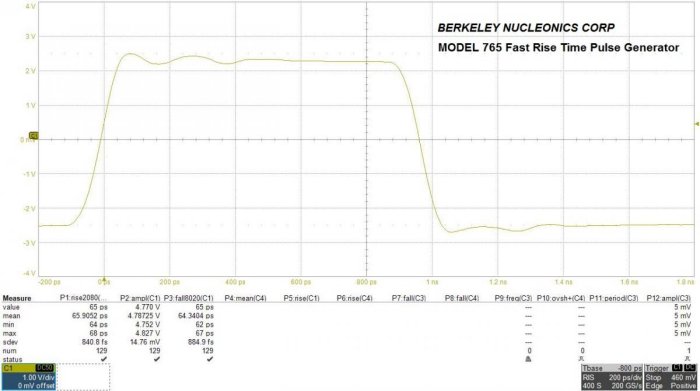
The Model 765 Fast Rise Time Pulse Generator offers 500 MHz frequency, 70 ps rise and fall times and adjustable pulse widths. The flexible pulser allows programmable amplitudes and offsets ( + / - 5V) and programmable widths down to 300 picosecond. Delay and Pulse Width resolution is 10ps and jitter is less than 25ps. The gesture-ready touchscreen GUI allows users to quickly set up 4 channels of output. Conventional push-buttons and a rotary encoder offer additional programming simplicity. We have made significant improvements in our analog front end as well, ensuring minimal overshoot and ringing. That`s just the beginning....the Model 765`s innovative hardware architecture provides advanced pulse sequences, such as double pulse or quad pulse, with fully independent timing parameters. Give us a call, we are happy to discuss your requirements.
- Channels: 2 or 4
- Rise and Fall Times: 70 ps
- Amplitude Peak to Peak: 200 mVpp to 5 Vpp Adj
- Width: < 300 ps to > 1 s
- RMS Jitter: < 25 ps
- Accuracy: ± (0.01% + 20 ps)
- Output Impedance: 50 Ohm Nominal
- Up to 4 channels
- < 70 ps rise/fall time (20%-80%)
- Adjustable output level from 10 mVpp to 5 Vpp
- Adjustable baseline offset ± 2.5 V
- Maximum repetition rate 500 MHz per channel
- Pulse width from 300 ps to > 1 s
- Width resolution 10 ps
- Continuous, single, burst, gated, external trigger modes
- Trigger in to output jitter < 35ps RMS
- 19″ rack-mount kit available (3U space required)
- Big physics applications
- Experiments colliders
- Lasers modulation
- Detectors
- Strips silicon emulation
- Mass spectroscopy
- TDT and TDR applications
- Radar and sonar systems
- Semiconductors tests
- MOSFET
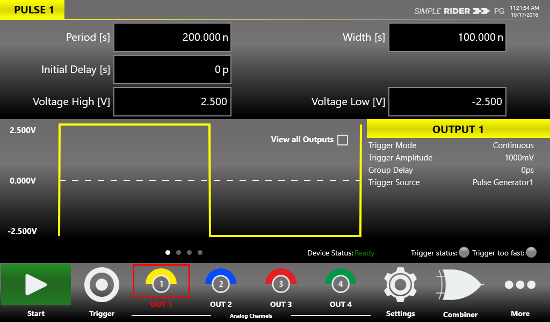
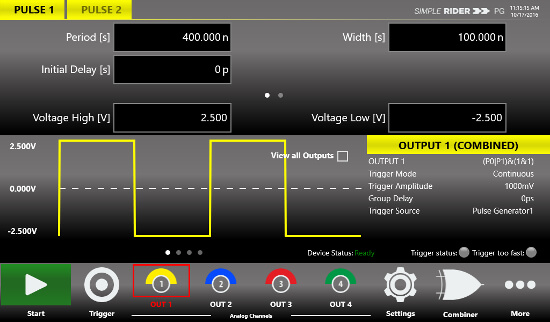
The Model 765 user interface is designed for touch and it has been developed to put all the capabilities of the modern Pulse and Waveform Generators right at your fingertips.
All instrument controls and parameters are accessed through an intuitive UI that recalls the simplicity of Tablets and modern smart phones: touch features and gestures are available to engineers and scientists to create single or multiple pulses (dual, triple and quadruple pulse mode) in few touches.