
- Home
- Companies
- Shandong GeoGro New Materials Co.,Ltd
- Products
- GeoGro - Filament Non-Woven Geotextile
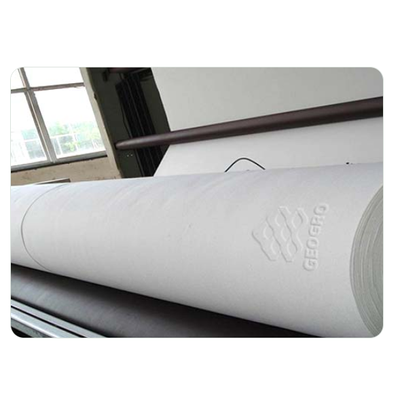
GeoGro - Filament Non-Woven Geotextile
GeoGro's Polyester filament geotextile is made directly by spinning and needle-punching and consolidating polyester filaments, it's made by forming and consolidating polyester filaments, the fibers are arranged in a 3D structure.Polyester filament non-woven geotextile has excellent heat resistance and light resistance, even if it is exposed to an environment of nearly 20 degrees for a short time, its performance is almost unchanged. After a large number of tests and practices, the polyester filament non-woven geotextile has long-term corrosion resistance to various natural soils, moisture and microorganisms.
- Roll Width:2m, 3m, 4m, 6m
- Roll Length:50m, 100m
- Color: white black
- Unit weight: 100g 150g 200g 250g 300g 350g 500g
GeoGro's Polyester filament geotextile is made directly by spinning and needle-punching and consolidating polyester filaments, it's made by forming and consolidating polyester filaments, the fibers are arranged in a 3D structure.Polyester filament non-woven geotextile has excellent heat resistance and light resistance, even if it is exposed to an environment of nearly 20 degrees for a short time, its performance is almost unchanged. After a large number of tests and practices, the polyester filament non-woven geotextile has long-term corrosion resistance to various natural soils, moisture and microorganisms. 
GeoGro's PET geotextile performance
Physical properties: Physical properties: Pet geotextiles generally have a higher weight, a larger thickness, and good uniformity.
Mechanical behavior: Has high dry and wet tensile breaking strength and seam joints High strength, elastic modulus, impact resistance, creep resistance, tear resistance, etc.
Hydraulic performance: For projects with filtration and anti-filtration performance, polyester spunbond needle-punched geotextiles are required to have a higher permeability coefficient; but for anti-seepage projects, polyester spunbond needle-punched geotextiles are required to have smaller permeability coefficient.
Durability: The polyester spunbond needle-punched geotextile must have weather resistance, chemical corrosion resistance, biological resistance and physical damage resistance.
Filter layer
The role of the filter layer mainly refers to the two aspects of filtration and reverse filtration. The pet geotextile produced by GeoGro can make liquid (mainly water) pass through the structure smoothly, while ensuring that the soil particles as the skeleton do not lose with the water flow, but at the same time Allow water to flow through soil particles and sand to ensure the stability of the soil structure.
Drainage
The GeoGro's pet geotextile has excellent water conductivity and can form a drainage channel in the soil structure to discharge excess liquid and gas in the structure.
Isolation
GeoGro's pet geotextile also has the function of separating two different materials without mixing. Prevent the penetration or mixing between the two materials, maintain the overall structure and functional material system, and improve the load-bearing capacity of the structure.
Reinforcement
The GeoGro's geotextile buried in the soil can disperse the stress in all directions inside the soil, improve the separation modulus of the soil, and transmit tensile stress, thereby limiting the possible displacement of the soil in all directions and increasing the polyester The friction between the spunbond needle-punched geotextile and other materials and between the soil medium can improve the stability of the soil and related buildings.
Protective effect
As a protective material, GeoGro's geotextiles can effectively diffuse, transfer or decompose stress, and prevent soil structures from being damaged by external forces.
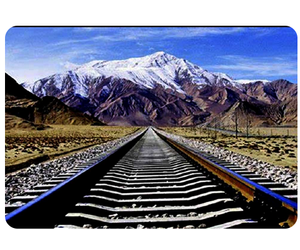
GeoGro Railway embankment
Placing the geocell at the bottom of the track bed (top of the foundation bed) can improve the bearing characteristics of the roadbed, so that the stress of the load transferred to the soil under the cell is reduced, so the deformation of the soil is also reduced.