

AET - Fill Media Packs
Wastewater treatment systems using biofilms that grow attached to a support media can be either an alternative or an improvement to the widely used suspended growth activated sludge process. When the system is operated with a single pass and without return sludge it is called FBBR (Fixed bed Biofilm reactor) or MBBR (Moving bed bio reactor). Especially for industrial pretreatment FBBRs are a good and advantageous alternative to activated sludge processes. If the system is operated with return sludge it is called IFAS (Integrated Fixed- Film activated sludge). IFAS systems are an easy and effective way to upgrade an existing activated sludge process by increasing the sludge amount (MLSS) in the aeration basin by up to 50%.
AET provides engineering consultation and product solutions for FBBRs, MBBRs, IFAS systems and trickling filters.
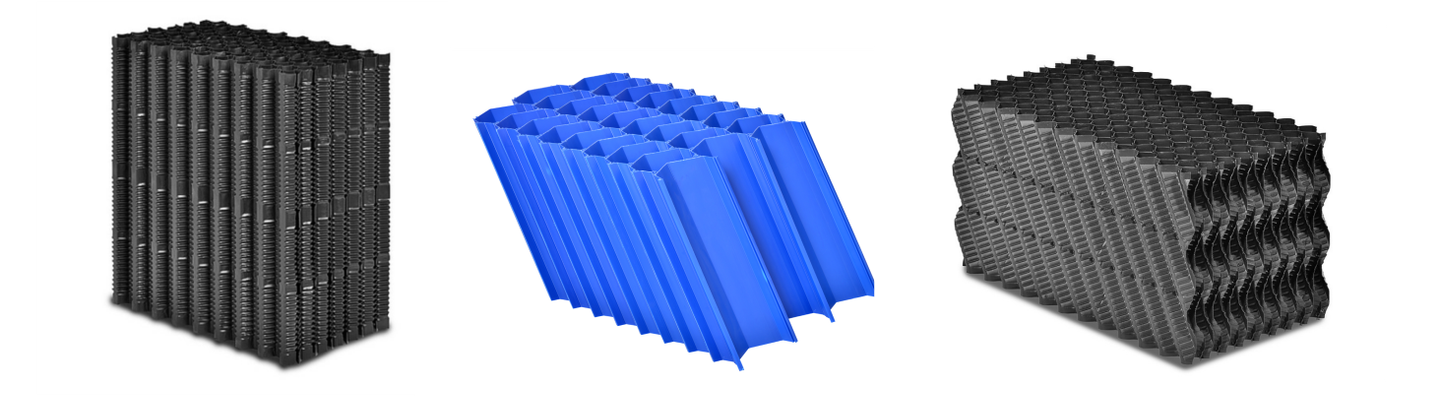
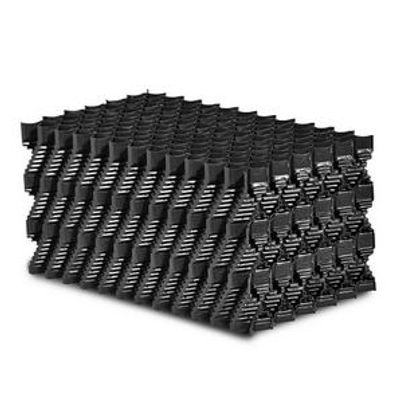
Fill media for water and wastewater applications is used as a carrier medium for Bio-film growth. The fill media blocks consist of corrugated foils which can be manufactured in various forms. These various forms result in different surface areas and channel designs. Additionally, fill media blocks can be manufactured from either Polypropylene (PP) or Polyvinyl Chloride (PVC). Moreover, our customers benefit from a customized fill media solution for their individual project case.
Fixed-bed biofilm reactors use fill media with a vertical flow channel shape. The vertical channel shape facilitates an easy sludge discharge for high organic loadings. This is due to increased biomass growth in FBBR applications. Depending on our customer needs, we design the appropriate fill media which provides the maximum allowable surface area. This also ensures an even distribution of liquid and air for the best treatment results. To learn more, contact us through our inquiry form
- BOD removal and complete nitrification
- Upgrade of existing activated sludge processes
- Pretreatment of industrial waste water
- Smaller municipal WWTPs
- High organic loadings or high content of compounds with low biodegradability
Examples: Food processing and beverages, Dairy, lagoon bypasses, chemical, leachate, Pharmaceutics, Energy, Pulp and Paper and more.
- Easy and fast installation for existing tanks
- Low energy consumption
Higher performance through increasing sludge-age and active biomass - Improved sludge settling characteristics
- High resistance against toxic or complex substances
- No immediate impact of electric shutdowns
- Low overall cost