


- Home
- Companies
- Likusta Umwelttechnik GmbH
- Products
- LIKUSTA - Filter Systems
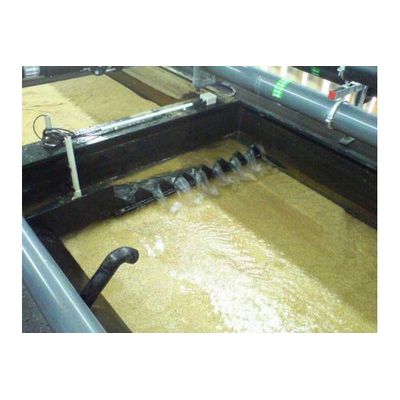
LIKUSTA - Filter Systems
The treatment of water polluted with solids is carried out in most cases with filter systems. They operate according to the sedimentation principle. Suspended matter is retained in the filter and deposited. The filtered water can subsequently be diverted and used. Nature serves as a model for this principle: Bank filtrate is water that is constantly trickling through the river bed and soil into the ground water. On its way through the different soil layers, the water is cleaned.
Filter systems are used in almost all areas of water treatment, including
- Drinking-water treatment
- Waste-water treatment, e.g. as pre-treatment prior to filtration or for final treatment according to biological aeration methods
- Industrial process water treatment, e.g. in the paper and pulp industry
Various system types are suitable for obtaining water free of suspended particulates. With gravel and sand filters, waste water is passed through a filter system, which is filled with mineral material of ever-finer grain (“from coarse to fine” filter principle).
In order to meet the requirements of the respective process, Likusta builds all filter systems individually according to the wishes and needs of our customers.
A special construction of filter systems are lamella filters (also: lamella system, lamella unit or lamella separators). Lamella treatment systems are economical and particularly space-saving filter types for optimised sedimentation. With lamella treatment systems, the actual filtration area is divided into several individual, overlapping filter elements. Thus a large filter area is achieved in a small space. This allows optimised sedimentation as well as compact system design.
Contaminated water is introduced into a specially dimensioned inlet chamber. From there, it runs upwards between the filter elements. Sedimentation occurs during the process: The solids settle on the lamellae and slide into the sludge funnel into the tank bottom. The sludge collected here is thickened and pulled off.
The control of the inflow is very important for efficiency and economy: All filter elements must be uniformly flowed through, and the separating of already sedimented particles must be prevented.
One advantage of Likusta filter systems is that the tanks are made of plastic and are therefore more resistant to corrosion than tanks made from other materials.