


- Home
- Companies
- Aquafix, Inc.
- Products
- Foam Buster - For Foaming Filaments
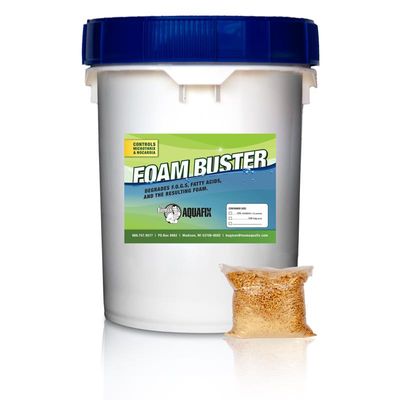
Foam Buster - For Foaming Filaments
Foam Buster, our best foam-fighting technology, is a blend of specialized proteins, free amino acids, and micronutrients which stimulate the floc-forming bacteria to degrade grease, emulsions, and petroleum hydrocarbon-based products and enable the bacteria to outcompete the filaments which cause foaming. Foaming filaments like Nocardia, Gordonia amare, and Microthrix parvicella use the fat, oil, and grease as well as their fatty acid by-products to produce a buoyant fatty cell wall. Foam Buster provides the naturally occurring bacteria a chance to compete.
Dive into why filaments are causing foaming in your plant with our Common Filament Guide.
If you suspect you have bulking filaments, see our Accelerator 7.
Foam Buster is effective in the oxidation ditches, activated sludge plants, SBRs, extended aeration waste water treatment plants, and aerobic digestors. All these areas can be infiltrated by Foam-causing, F.O.G.-hungry filaments like Microthrix Parvicella, Nocardia, and Type 1863. Foam Buster also works well on the bulking filaments Type 021N and Type 0092.
Foam Buster’s control of these filaments can be supported by heavy wasting programs and Qwik-Zyme L, a biocatalyst that specifically attacks the fats, oil, grease, and fatty acids that filaments use for food.
Even More Than an Energy Drink
Most bacteria in wastewater plants are unmotivated and listless. Part of Foam Buster’s micronutrient blend is formulated to give the filament-degrading bacteria extra boosts of energy that allow them to degrade the filaments faster than they can reproduce and get rid of the foam. As the graph shows, Foam Buster allows wastewater bacteria to degrade filaments while contributing a much lower amount of their own energy.
But Foam Buster supports filament degradation in more ways than energy. Its formula also contains nutrients specifically needed by the bacteria to create certain foam-busting biocatalysts. A bacon grease molecule is different from a butter molecule is different from a filament molecule, and Foam Buster provides the right array of micronutrient ingredients to allow the bacteria to produce the specialized recipes for biocatalysts to attack these different molecules.
Settling Issues Solved
Foam Buster also contains minerals, surface-tension depressants, and natural buffering systems, all of which work together to rid your plant of surfactant and emulsion chemistries as well as F.O.G. and fatty acids.
Not a Band-Aid
A lot of times when a wastewater plant gets foam they will use a chemical defoamer or an anti-foam to knock the foam down. Chemical defoamers work by covering up the problem for a period of time. In addition chemical defoamers can cause sludge bulking issues, nitrifier toxicity, and are limited in that they do not control Nocardia or surfactant foams. Silicone anti-foams break down into siloxanes which corrode combustion engines. Neither type of product truly addresses the root cause of the problem.
Foam Buster addresses the cause of the foam and provides bacteria with the tools they need to digest and break it up. And because you never know when an influx of grease or surfactants can hit, Foam Buster has a maintenance dose to keep your bacteria crisis-ready and we offer DeFoam 3000, which is an organic defoamer that is easy on the biology and functions as a fast-acting temporary fix. For especially tough issues, use the synergistic combination of Foam Buster and Qwik-Zyme L. Qwik-Zyme L helps to get the grease under control while Foam Buster alters the bacteria populations so the foam will not return.
- Oxidation Ditches
- SBRs
- Extended Aeration Wastewater Treatment Plants
- Aerobic Digestors
- Reduces and eliminates foam
- Reduces sludge and scum production
- Eliminates negative impacts from incoming fat, oil, and grease
- Improves settling
- Increases good bacterial populations
- Lowers effluent BOD and TSS
- Degrades surfactants and emulsions